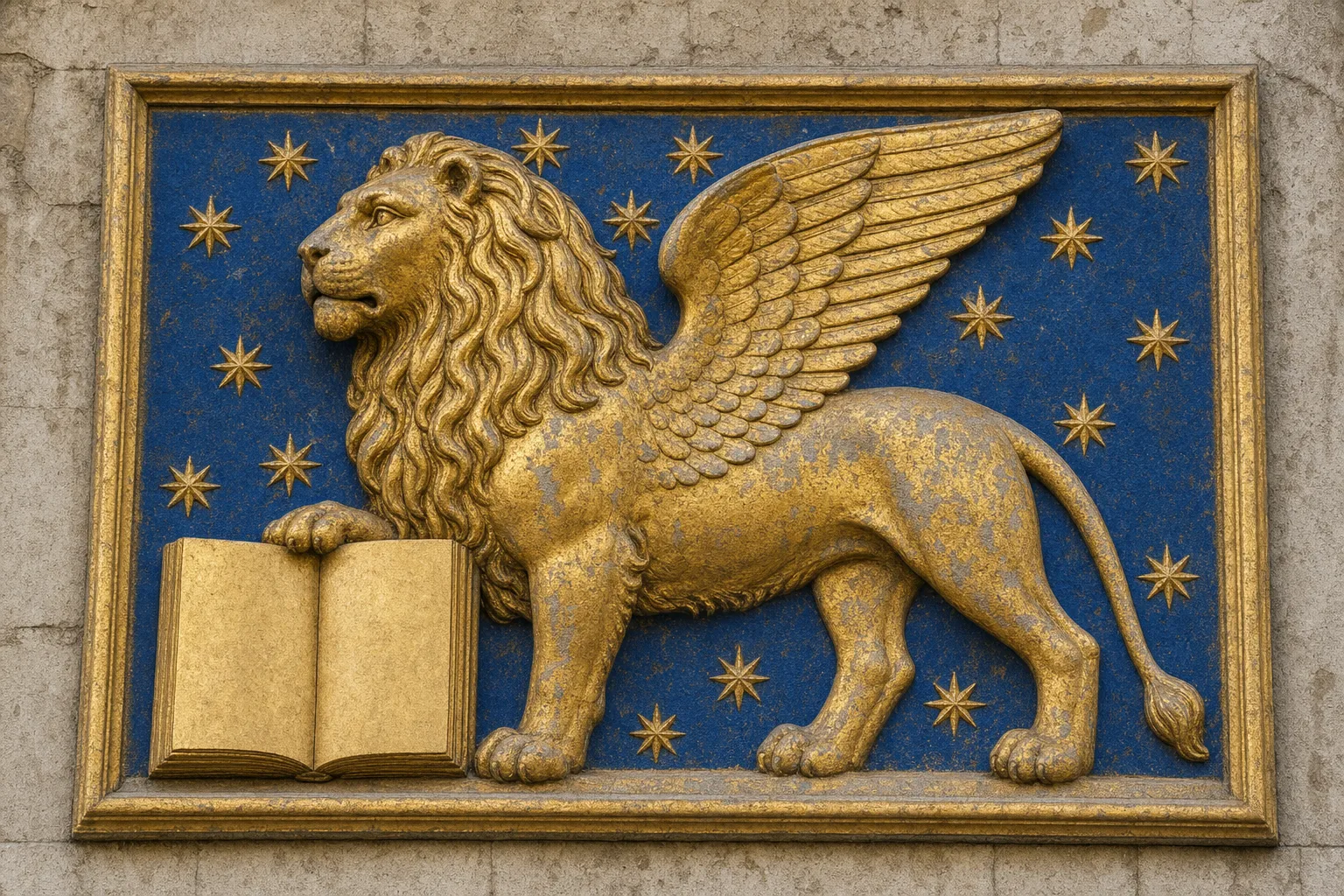
The winged lion enters Christianity twice: once as a face on a vision, and once as a beast with a book. The first arrival is textual and happens in exile in Babylonia around 593 BCE; the second is a decision taken by Latin commentators seven or eight centuries later, and it is a decision, not a revelation - the earliest writers who made it disagreed with each other about which evangelist got which creature. Everything afterwards - the tympana, the gospel books, eventually a maritime republic's flag - rests on the arrangement that happened to win.
By the river Chebar
Ezekiel is a deported Judaean priest living among other deportees on a canal in southern Mesopotamia. His opening vision is of a storm out of the north and, within it, four chayyot, living creatures, each with four faces, four wings, straight legs with calf's hooves, human hands beneath the wings, and burning coals moving between them. Beside each is a wheel, and the wheels are full of eyes. In a later passage the prophet identifies the same creatures as cherubim.
The visual context matters. The audience for this vision was living in the heartland of the very art discussed inthe Mesopotamian chapter: colossal human-headed winged bulls and lions at gateways, glazed lions along processional walls, bird-headed winged genii on palace reliefs. A four-faced composite made of man, lion, ox and eagle is not a random assemblage. It is the standard Mesopotamian guardian grammar - human intelligence, feline strength, bovine endurance, avian flight - restated as a single throne-bearing creature, and the throne it bears has no image on it. The winged hybrid that had carried Near Eastern kingship, and that already carriedthe cherub-throne of the Jerusalem temple, is here turned into a vehicle for a God who cannot be depicted.
Four beasts around the throne
Revelation reworks the vision and, crucially, separates it. Where Ezekiel has four creatures each with four faces, the seer of Revelation has four distinct beasts around the throne, each with six wings and covered in eyes - the wings borrowed from Isaiah's seraphim - and each with a single identity: lion, calf, one with a face like a man, and a flying eagle. The lion is named first.
"And the first beast was like a lion, and the second beast like a calf, and the third beast had a face as a man, and the fourth beast was like a flying eagle."
Revelation 4:7
This separation is what makes the later iconography possible. Four faces on one body is difficult to carve and impossible to distribute; four separate animals can be put in the four corners of an apse, the four corners of a page, or the four quadrants of a tympanum - and can be assigned, one each, to four authors.
The Christian winged lion at a glance
- Names
- chayyot, the living creatures of Ezekiel; cherubim; the four beasts of Revelation; Greek tetramorphos for the composite of all four; in the West, the lion of Saint Mark.
- Body plan
- A lion with feathered wings, standing or seated, usually haloed. Late antique and Byzantine versions often show only a winged bust; Western medieval versions show the whole animal, upright on its hind legs or couchant with one paw on a book.
- Scriptural roots
- Ezekiel 1 and 10 for the four-faced cherubim, Isaiah 6 for the six-winged seraphim, Revelation 4 and 5 for the four beasts and for the Lion of the tribe of Judah, Genesis 49:9 for the lion of Judah itself.
- Where it appears
- Apse and triumphal-arch mosaics, Romanesque and Gothic tympana, gospel-book symbol pages and evangelist portraits, ivory book covers, enamel and metalwork crosses, choir screens, pulpits and font bases.
- Attributes
- Nimbus, and an open or closed codex - the gospel itself. Venetian versions inscribe the book with the formula Pax tibi Marce evangelista meus, and add a sword, wings raised, and sometimes water and land beneath the paws.
- Where to see it
- The apse and arch mosaics of Rome and Ravenna, the west portals of French Romanesque and Gothic churches, and the insular gospel books - the Book of Kells and the Book of Durrow in Dublin, the Lindisfarne Gospels in London, the Echternach Gospels in Paris.
Who gets the lion
Nothing in Ezekiel or Revelation connects the creatures to the gospels. That connection is made by second- to fifth-century commentators, and they made it differently from one another. Irenaeus of Lyons, in the late second century, gives the lion to John, whose gospel opens with the eternal Word and is therefore, in his reading, the royal and princely one; Mark, whose gospel opens with a prophetic citation, receives theeagle. Augustine, working from a different criterion - what each gospel emphasises about Christ - gives the lion to Matthew, because Matthew opens with a royal genealogy and dwells on Christ's kingship, and assigns the man to Mark. Jerome, whose arrangement became the Western standard through the authority of his prefaces and the Vulgate tradition, keys the symbols to the opening of each gospel and produces the set that everyone now recognises.
| Gospel | Irenaeus | Augustine | Jerome (the Western standard) |
|---|---|---|---|
| Matthew | Man | Lion | Man |
| Mark | Eagle | Man | Lion |
| Luke | Ox | Ox | Ox |
| John | Lion | Eagle | Eagle |
Why Mark
Jerome's criterion is the first sentences. Matthew begins with the human ancestry of Christ, so Matthew takes the man. Luke begins in the temple with Zechariah and the sacrifice, so Luke takes the ox, the sacrificial animal. John begins above the world, so John takes the eagle. Mark begins with the prophecy of a voice crying in the wilderness and with John the Baptist appearing in the desert - so Mark takes the lion, the animal whose voice is heard in the wild places.
The fit is better than a mnemonic. The desert is where the lion of the Bible lives, and the roar is the sound of the gospel's opening. Mark's narrative is also the fastest and most abrupt of the four, and medieval commentators were happy to make that a lion's quality as well. The earlier writers were reasoning from a different premise - Irenaeus from the character of each gospel's theology, Augustine from its portrait of Christ - and both are perfectly coherent systems that simply produce different animals. What settled the matter was not argument but use: the arrangement that got copied into the gospel books got copied onto the buildings.
Apse, tympanum and gospel book
Once the four beasts are separate and assigned, they become a way of framing Christ. In the late fourth-century apse mosaic of Santa Pudenziana in Rome the creatures appear in the sky above the enthroned Christ; the composition recurs, with variations, through the Roman and Ravennate mosaic programmes. The Romanesque west portal takes the same arrangement and makes it architecture: Christ in Majesty in a mandorla at the centre of the tympanum, the four creatures filling the corners around him, the lion normally at one of the upper positions. The great French examples - Moissac, and the central portal of the Royal Portal at Chartres - are essentially the apse composition transferred to stone at the door, which is to say: transferred to the threshold.
In manuscripts the beasts do something else again. Insular gospel books place a full-page symbol before or facing each gospel, or gather all four on a single page as a four-part emblem. The Book of Durrow uses the creatures as flat, patterned emblems set in interlace frames. The Echternach Gospels contain one of the most striking of all such pages, a lion drawn as a linear, high-shouldered, deliberately abstract animal within a frame. The Lindisfarne Gospels and the Book of Kells combine the older emblem tradition with author portraits in a Mediterranean manner, so that the evangelist and his beast appear together - the writer and the thing that identifies his writing.
The book and the formula
The beast becomes an attribution device, in the strict sense: a mark that tells you whose text you are holding or whose altar you are facing. Its standing attributes are a nimbus and a codex. When the book is closed, the lion is the gospel's guardian; when it is open, the lion is the gospel speaking, and workshops frequently write something on the exposed page.
In Venetian versions the open book carries the wordsPax tibi Marce evangelista meus - peace to you, Mark, my evangelist. This is not scripture. It comes from a medieval Venetian legend in which an angel greets Mark with those words while the saint is storm-bound in the lagoon, foretelling that his body will rest there. The formula is therefore a claim, and its appearance on the open book converts an evangelist's emblem into a territorial title.
The moralised lion
Running parallel to the evangelist tradition is the Physiologus, a Greek compilation of moralised animal lore from late antiquity that becomes, in Latin translation and expansion, the medieval bestiary. Its lion entry is among the most influential passages in medieval symbolism, and it gives the lion three natures: it sweeps away its tracks with its tail when hunted; it sleeps with its eyes open; and its cubs are born lifeless and are roused on the third day by the roar or breath of their father.
Each is read straight onto Christ - the concealment of divinity in the incarnation, the divinity awake while the body lies in the tomb, and the resurrection on the third day. Those three readings, plus Jacob's blessing of Judah as a lion's whelp in Genesis and the Lion of the tribe of Judah who alone can open the scroll in Revelation 5, give the medieval West a lion that is unambiguously a figure of Christ. A carved lion in a church is therefore doing at least two things at once: identifying Mark, and standing for the risen Christ.
Thresholds, and the political turn
Medieval architecture puts lions back where the ancient world had them: at the door. Italian Romanesque churches - Modena, Ferrara, Parma and their relations - stand their porch columns on the backs of crouching stone lions, the so-called stylophoric lions, often with prey beneath the paws. Lions guard the steps of pulpits, carry the bases of fonts, sit at the feet of tomb effigies and appear as corbels and door-jamb beasts. Whether the carver thought of Mark, of Christ, of the devouring lion of the psalms, or simply of the ancient convention that a threshold needs an animal, the position is the same position the lamassu held, and the archive'sopening chapter treats that continuity as the motif's central fact.
The last turn is political. In 828 Venetian merchants removed relics venerated as the body of Saint Mark from Alexandria and brought them to Venice, and the city adopted the evangelist as its patron. His emblem went with the patronage. Within a few centuries the winged lion with the open book was not primarily an author's symbol at all: it was carved on fortifications, flown at sea, stamped on coins and set up in every subject town as the sign of a government. How a scriptural creature became a state's trademark, and how heraldry then spread it across Europe, belongs to a later chapter of this archive.