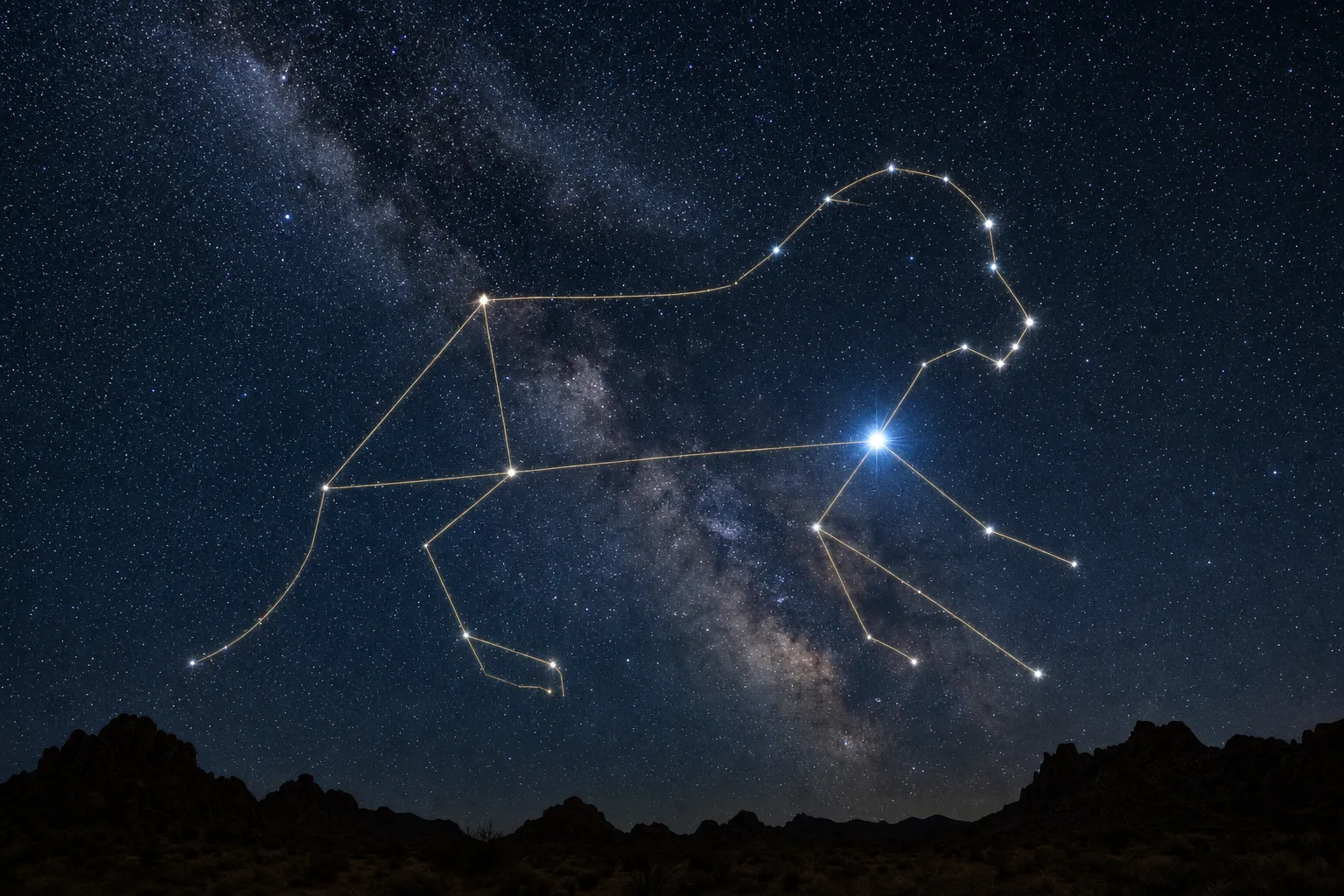
Leo is one of the few constellations that actually resembles what it is named for. A curved line of stars makes a head and mane, a bright star sits at the front of the chest, and a triangle behind them closes the hindquarters and the tail. That legibility is probably why the figure is one of the oldest we can trace: the lion was a lion in Babylonian star lists, and it is still a lion on a modern chart, with the same stars doing the same work.
The Great Lion of the star lists
Mesopotamian astronomy knew the group as UR.GU.LA, the Great Lion. It appears in MUL.APIN, the two-tablet compendium collecting Babylonian star lists, rising schemes and calendrical rules; the earliest surviving copies date from the early seventh century BCE, while the observational content behind them appears to reflect a sky some centuries older. Inside that lion sat the starLUGAL, the King — Regulus, the subject ofits own chapter.
The figure passed into Greek astronomy as Leon, was catalogued by Ptolemy in the Almagest with essentially the outline still in use, and survived the modern reorganisation intact. When the International Astronomical Union fixed constellation boundaries in 1930, Leo became a defined region of sky rather than a pattern of stars, and it ranks among the dozen or so largest of the eighty-eight. A constellation in the modern sense is a piece of territory: everything inside its borders is said to be in Leo, whether or not it has anything to do with the lion shape.
The Sickle and the principal stars
The head and mane form the Sickle, six stars arranged in a backwards question mark — Epsilon, Mu, Zeta, Gamma and Eta Leonis curving down to Regulus at the base. The hindquarters are a right-angled triangle of fainter stars: Denebola at the tail, with Zosma and Chertan above it. Learn those two shapes and the constellation follows.
| Star | Bayer | Meaning of the name | Approx. magnitude |
|---|---|---|---|
| Regulus | α Leonis | Latin, the little king; the Arabic name meant the heart of the lion | About 1.4 |
| Denebola | β Leonis | From Arabic Dhanab al-Asad, the tail of the lion | About 2.1 |
| Algieba | γ Leonis | From Arabic al-Jabha, the forehead | About 2.0 combined; a close double |
| Zosma | δ Leonis | From Greek, a girdle or belt | About 2.6 |
| Ras Elased Australis | ε Leonis | From Arabic Ra's al-Asad, the lion's head, plus Latin for southern | About 3.0 |
| Chertan | θ Leonis | From Arabic, usually explained as the two small ribs | About 3.3 |
Two oddities there are worth explaining. Algieba means the forehead yet sits in the mane, and Zosma, a girdle, marks a point on the lion's back. The mismatch is a residue of transmission: the pre-Islamic Arabian sky had its own enormous lion spanning a far wider stretch of the ecliptic than the Greek figure, and body-part names coined for that animal were later reattached to stars in the smaller Greek Leo, where they no longer land in the right place. Names in the sky are historical deposits, not descriptions.
Algieba repays a small telescope, resolving into a pair of golden-yellow stars a few arcseconds apart. Denebola is a nearby white A-type star, about thirty-six light years away, notable for the infrared excess that indicates a disc of dust around it.
A sign is not a constellation
A constellation is an area of the sky. Since 1930 the eighty-eight have had exact boundaries drawn along lines of right ascension and declination, and they are wildly unequal in size. The Sun, moving along the ecliptic, spends over a month inside Virgo and only about a week inside Scorpius; the ecliptic also clips the corner of Ophiuchus, a thirteenth constellation that has always been on the Sun's path.
A sign is a thirty-degree slice of the ecliptic, twelve of them dividing the circle exactly and equally. In the tropical zodiac used in most Western astrology the slices are measured from the vernal equinox point, defined by the geometry of Earth's axis and orbit rather than by any star. In the sidereal zodiac used in Indian astrology they are anchored to the stars instead, which is why the two systems give different answers.
The practical consequence: the Sun is in the sign Leo from roughly 23 July to 22 August, and inside the constellation Leo from roughly 10 August to 16 September. Both statements are correct. They answer different questions.
Precession and the drifting dates
Earth's axis traces a slow cone, completing one circuit in roughly 25,800 years. The equinox point therefore slides westward along the ecliptic at about fifty arcseconds a year — one degree every seventy-two years, a full sign every couple of thousand.
Against the fixed calendar of the seasons, that means the date on which the Sun reaches any given star gets steadily later. The Sun now passes Regulus around 22 August; in the Hellenistic period it did so nearly a month earlier, in late July. When Greek and Roman writers associate the Lion with the fiercest heat of the year, they are reporting their own sky accurately; it is the calendar relationship that has moved, not their observation that was wrong. The same drift carried Regulus across the tropical Leo–Virgo boundary early in this century, and it is the mechanism behind the long-cycle language of astrological ages — a real cycle with a modern interpretive scheme laid over it.
The Nemean Lion, and Leo Minor
In Greek myth the constellation is the Nemean Lion, killed by Herakles as the first of his labours. Its hide could not be pierced by weapons, so he strangled it and afterwards wore the skin with the head as a helm — which is why Herakles is recognisable in art by a lion-scalp hood. The catasterism, the placing of the beast among the stars, is recorded in the Greek star-myth compilations: the Catasterismi attributed to Eratosthenes and Hyginus's De astronomia. The sources differ over who did the placing, some crediting Zeus in honour of the labour, others Hera, who was said to have reared the lion.
The chronology matters. The lion was in the sky under that name more than a thousand years before any surviving Greek telling of Herakles. The Nemean story is a myth attached to an inherited figure, not the reason the figure exists — a useful corrective to the habit of treating Greek myth as the origin layer of the sky.
Leo Minor, the small lion squeezed between Leo and Ursa Major, is a late addition: Johannes Hevelius invented it to fill an empty patch of sky in the atlas published in 1687. It carries a curiosity — no star in it is designated alpha, an omission usually blamed on the nineteenth-century cataloguer Francis Baily. Its brightest star is 46 Leonis Minoris, sometimes called Praecipua.
Solar lions and the Sphinx question
The association of the lion with the Sun is genuinely ancient and widespread. In Mesopotamia the lion was the royal animal and the Great Lion a summer constellation; the gate and throne lions discussed inthe Mesopotamian chapter belong to the same ideological world as the star list naming one of their stars the King. Egypt is solar in several registers at once: lion-headed Sekhmet as a burning aspect of the sun god, Aker as the double lion of the eastern and western horizons through which the sun passes, and lion-headed waterspouts on temple roofs. A late antique source, the Hieroglyphica of Horapollo, explains the lion as a sign of the Nile inundation because the flood came while the sun stood in Leo — but Horapollo writes many centuries after pharaonic practice, and Egyptologists treat his explanations as late rationalisation rather than evidence of Old Kingdom thinking.
The Sun's own house
In the Hellenistic system underlying all later Western astrology, Leo is the domicile of the Sun. The scheme is tidy and explains a great deal of later symbolism: the two luminaries take the two signs in which the Sun rides highest in the northern summer — the Moon Cancer, the Sun Leo — and the five visible planets then fan outward in order of distance, each taking one sign on either side. Mercury gets Virgo and Gemini, Venus Libra and Taurus, Mars Scorpio and Aries, Jupiter Sagittarius and Pisces, Saturn Capricorn and Aquarius.
Leo is classed as fixed, fiery, hot and dry, and diurnal. In medical astrology it governs the heart and, in some schemes, the spine — the assignment drawn on the zodiac-man diagrams found in medieval books of hours and in the folding almanacs physicians carried. The chain of Leo, the Sun, gold and the heart runs from there directly into the alchemical and Hermetic material set out in the esoterica chapter.
Observing Leo
Leo is a spring constellation for the northern hemisphere. It clears the eastern horizon on late-winter evenings, stands highest around local midnight in late February and March, and dominates the early-evening southern sky through April and May. From the southern hemisphere it appears low in the north and inverted, with the Sickle hanging the other way.
Galaxies
Leo looks out of the plane of our own galaxy, so it offers a clear line of sight into deep space and is rich in galaxies. The best known group is theLeo Triplet — M65, M66 and NGC 3628 — three spirals close enough to share a single low-power telescopic field, at a distance usually given as around thirty-five million light years. M65 and M66 are the easier pair; NGC 3628 is edge-on, split by a dust lane, and needs darker skies. A few degrees away lies a second cluster of the same group: the barred spirals M95 and M96 with the elliptical M105 nearby.
The Leonids
Leo in the sky
- Oldest recorded name
- UR.GU.LA, the Great Lion, in Babylonian star lists including MUL.APIN
- Brightest star
- Regulus, magnitude approximately 1.4
- Key asterisms
- The Sickle for the head and mane; a triangle for the hindquarters
- Sun in the sign
- Approximately 23 July to 22 August, tropical zodiac
- Sun in the constellation
- Approximately 10 August to 16 September
- Best viewing
- Northern hemisphere evenings, roughly February to May
- Meteor shower
- The Leonids, peaking around 17–18 November; parent comet 55P/Tempel–Tuttle
For the star at the centre of all this — its physics, its names, and why one star half a degree from the ecliptic accumulated four thousand years of royal symbolism — see Regulus. For the symbolic readings the lion attracted once it was given wings, seeEsoteric Meanings of the Winged Lion.