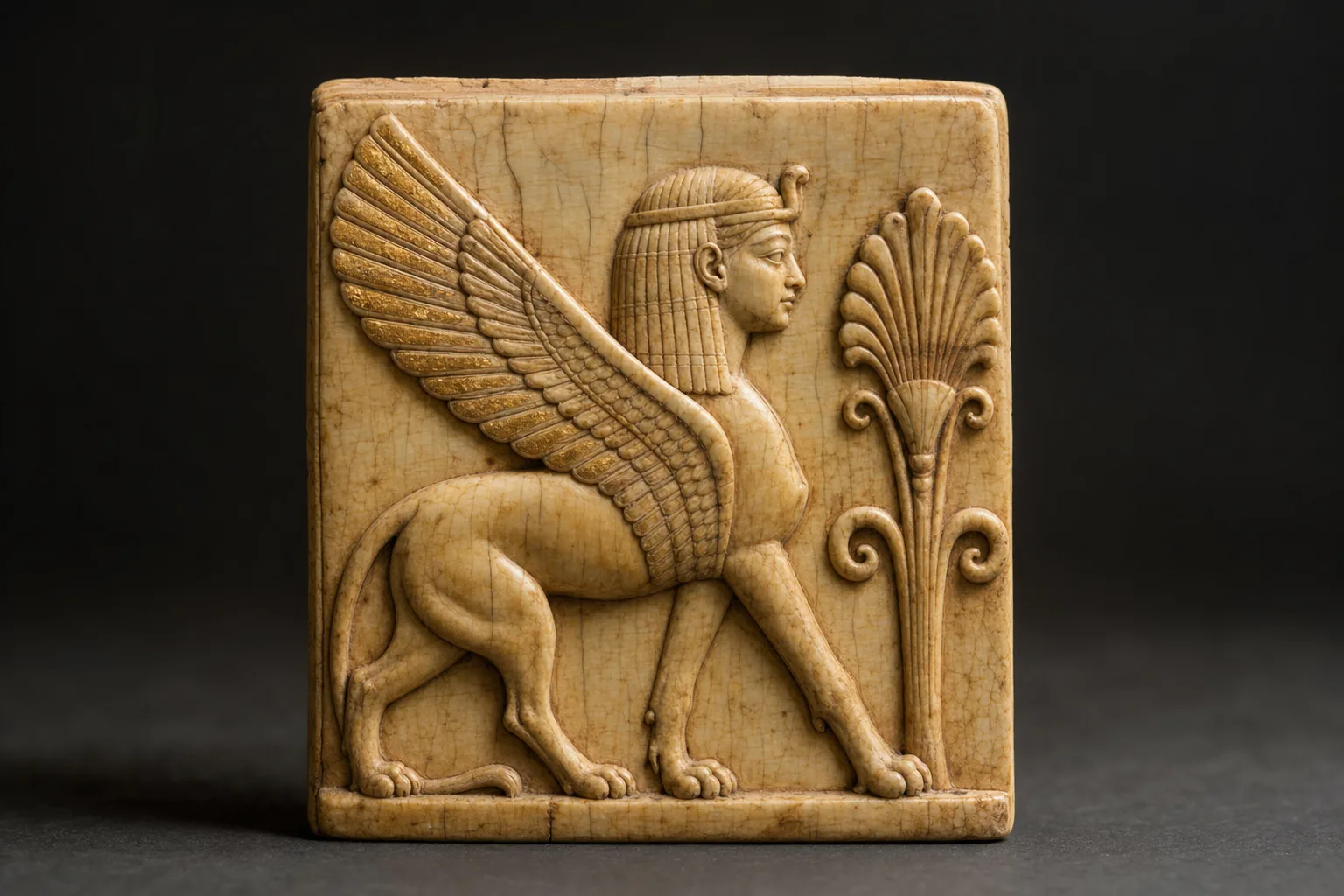
A strip of coast and hill country roughly six hundred kilometres long, never politically unified, produced the version of the winged lion that the largest number of people would eventually inherit — not because the Levant invented it, but because it stood between the two civilisations that did and passed the result into a text that outlived every kingdom named here.
The corridor between empires
Canaan, Phoenicia, Israel, Judah, Aram and the Philistine cities occupied the only practicable land route between Egypt and Mesopotamia. Armies used it, and so did caravans, craftsmen and pattern books. Levantine art is not a diluted version of its neighbours but a working synthesis, made by people fluent in two grammars at once.
From Mesopotamia the region took the guardian logic — the composite creature stationed at a threshold, in facing pairs, doing a job. From Egypt it took the sphinx: the striding lion-body with a human head, along with solar discs, nemes headcloths, lotus and papyrus, cartouche frames and winged scarabs. What the Levant added was wings on the sphinx as standard equipment — Egyptian sphinxes are usually wingless, Levantine ones usually are not — and a preference for small, precious, portable media over monumental stone.
That last point governs everything else here. Assyria carved guardians four metres high; the Levant carved them four centimetres high, in ivory, and sold them.
The Levantine winged lion at a glance
- Names
- Sphinx (modern convention, after the Egyptian type); Hebrew kerub, plural kerubim; the Phoenician and Aramaic terms are not securely recovered
- Body plan
- Lion body, two wings usually curving upward or swept back, human head — often female, often in an Egyptianising wig or headcloth
- Typical medium
- Carved ivory and bone inlay, bronze, gold leaf, moulded terracotta, carved and gilded wood (almost entirely lost), stone sarcophagi
- Where they appear
- Furniture panels and bed frames, throne sides, cosmetic boxes, horse trappings, temple wall panelling, cult stands, sarcophagi
- Key finds
- The Megiddo ivory hoard; the Ahiram sarcophagus at Byblos; the Nimrud, Arslan Tash and Samaria ivories; the Taanach cult stand
- Where to see them
- British Museum; Louvre; Metropolitan Museum of Art; Israel Museum and the Rockefeller, Jerusalem; National Museum of Beirut; Chicago's Institute for the Study of Ancient Cultures
The Canaanite winged sphinx
By the Late Bronze Age the winged sphinx is standard furniture ornament across the southern Levant. It appears on carved ivory panels pinned to wooden beds, chairs, boxes and chariot fittings; on bronze bowls and stands; on scarab and stamp seals; occasionally in the round as a small figurine. The pose is nearly always the same: striding to one side, head in profile or turned to face the viewer, one wing raised and the other lowered, frequently paired with a stylised palmette or sacred tree.
Two features separate the Levantine version from its Egyptian model. It is winged, and the wings are ornamental in a way Egyptian wings are not — the feathering divided into decorative registers, the tips curled. And its head is frequently female, in a heavy tripartite wig, where Egyptian royal sphinxes carry the king's own features. The result is a guardian and an ornament at once, which is what high-status furniture requires.
Megiddo, Byblos and the sphinx throne
Two objects carry the argument of this chapter almost by themselves.
The first is the ivory hoard from Megiddo, several hundred worked pieces recovered from a room beneath the Late Bronze Age palace on the mound. Among them is a long narrow plaque with a two-part scene: at one end a ruler sits on a high-backed throne drinking from a bowl, attended by a woman with a lyre; at the other, a figure rides in a chariot behind bound prisoners. The throne is the point. Its side is formed by a winged sphinx — lion body, wings, human head — so that the ruler is physically supported by the creature.
The second is the stone sarcophagus of Ahiram of Byblos, on which a king sits on a throne whose sides are again winged, lion-bodied sphinxes, receiving a procession of offering-bearers. The same sarcophagus carries one of the earliest substantial inscriptions in the Phoenician alphabet. It is in the National Museum of Beirut.
The ivory workshops
In the early first millennium BCE the Levantine coast ran what amounts to a luxury export industry. Elephant ivory — from Syrian herds while they lasted, then from Africa — was carved into thin panels, openwork plaques and figurines, sometimes inlaid with coloured glass and semi-precious stone and overlaid with gold leaf. The repertoire is Egyptianising and highly standardised: winged sphinxes flanking palmettes, women at windows, striding griffins, lotus chains, figures in Egyptian dress performing rites no Egyptian would recognise.
Three findspots dominate. Nimrud produced by far the largest assemblage, from palace storerooms and from wells in the Northwest Palace where waterlogging preserved pieces that would otherwise have perished. Arslan Tash in northern Syria produced a smaller group, some of it bearing a short inscription naming a lord Hazael, generally connected with the Aramaean king of Damascus. Samaria, capital of the northern kingdom of Israel, produced fragments long read against the biblical notices of an "ivory house" and of beds of ivory.
The Nimrud material matters because it is Levantine work found in an Assyrian palace. Assyrian royal inscriptions record ivory, ivory furniture and craftsmen arriving from western states as tribute, and other consignments taken as plunder. Either way the motif moved east in the baggage of empire and was seen daily by the people who commissioned Assyrian palace art.
Cherubim: the same creature, renamed
The Hebrew kerub has been thoroughly disfigured by later art. The chubby winged infant is a Renaissance invention borrowed from the classical putto; nothing in the Hebrew Bible supports it. The biblical cherub belongs to the family described above — a winged, composite, guardian creature of the Levantine sphinx type — and behaves accordingly.
It appears first as a guard, stationed at the east of Eden with a turning flaming sword to block a route. It appears next as furniture: the ark is described with two cherubim of hammered gold at either end of its cover, wings spread over it and faces turned inward — a lid reproducing the sphinx-throne composition exactly, minus the occupant. The formula "the one who sits upon the cherubim" recurs through Samuel and the Psalms, and it describes that object: an empty throne whose armrests are winged creatures.
Solomon's temple scales it up. The account in 1 Kings gives the inner sanctuary two olive-wood cherubim overlaid with gold, ten cubits high, set side by side so that their outstretched wings touch each other at the centre of the room and the walls at either end. The same chapter describes the panelling.
Cherub, palm tree, open flower. That is the Phoenician ivory repertoire — winged sphinx, palmette, rosette — described in words, in a building whose construction the same text attributes to craftsmen sent from Tyre. The temple's decorative scheme and the carved panels in Assyrian storerooms are products of one artistic tradition.
Ezekiel, writing in exile after that temple was destroyed, gives the fullest description and the strangest: four living creatures, each with four faces — human, lion, ox and eagle — four wings, straight legs, calf's hooves, moving with wheels full of eyes. A later chapter calls the same beings cherubim outright. His temple vision then describes carved cherubim with only two faces, human and lion, turned towards the palm tree on either side: the ivory-workshop composition again, reported as description of panelling.
Wings as vehicle
One further biblical use tells us something the objects cannot. In the storm-theophany of Psalm 18 — repeated with small variations as the song in 2 Samuel 22 — the god does not sit on the cherub. He rides it. The King James wording is "he rode upon a cherub, and did fly", paired with "upon the wings of the wind". The halves of the line are parallel, which is the standard way Hebrew poetry defines a term: the cherub is functionally equivalent to the wind, a means of movement for a storm god descending in cloud and darkness. The verb differs between the psalm and the Samuel version, and translations split over whether the second word means "he flew", "he swooped" or "he was seen".
This is the clearest ancient statement of what wings are for in this motif. They are not ornament and not a species marker. They are the mechanism by which a power crosses from its own realm into this one — which is why the guardian at the door has them, and the throne has them, and the god in the storm has them. The symbolic readings later traditions built on the winged lion all start from this premise.
Taanach and the household object
Not all of this was royal. A terracotta cult stand found at Taanach, in the Jezreel valley, gives a compact view of Iron Age religious imagery at a smaller scale. It is a rectangular tower of moulded clay in four registers: a female figure grasping two lions; two winged, human-faced sphinxes flanking an empty space; a stylised tree with flanking ibexes and lions; and a quadruped beneath a winged disc.
The register with two sphinxes and nothing between them is the one always argued about. Read one way it is an aniconic throne, the same empty seat as the ark in provincial terracotta; read another way the gap is a doorway and the sphinxes are guarding it. Scholars also disagree about which deities the registers represent. The stand is worth citing not for a settled reading but because it shows the sphinx-throne convention in ordinary use, outside a palace and in cheap material. Comparable pieces turn up across the Iron Age Levant: sphinxes on provincial ivory inlays, on officials' stamp seals, on bronze stands, on horse blinkers.
The iconoclastic turn
A culture that carved cherubim on every wall of its central sanctuary is the same culture that transmitted a prohibition on carved images. The tension is real and the biblical text does not hide it: the ark's cherubim are commanded in the same body of law that forbids making a likeness of anything in the heavens or on the earth. Whatever the prohibition was originally understood to cover, it plainly did not cover these.
The usual reconstruction is that the ban tightened over time, driven by reform movements in Judah and consolidated during and after the Babylonian exile, and that it was aimed at cult images — representations that could receive worship — rather than at ornament. Cherubim survived because they were furniture: supports, panelling, the empty throne's armrests, never the recipient of an offering. After the Second Temple period the winged composite largely leaves Jewish visual practice, resurfacing as decoration in late antique synagogue floors and much later as a diagram inmystical literature, where Ezekiel's chariot becomes a subject of contemplation rather than a picture.
Two roads lead out of this chapter. Westward, the winged lion entersGreece, where the imported sphinx acquires a riddle and a body count and the griffin is posted to the edge of the world to guard gold. Forward in time, Ezekiel's four-faced creature is read alongside the four beasts of Revelation and the lion-face is assigned to an evangelist — the beginning of the career traced inChristian Tradition. The editions and excavation reports behind this chapter are listed inSources.