The floodplain between the Tigris and the Euphrates has no native lions with wings and no native eagles with paws, but it produced both, in quantity, for something close to three thousand years. Unlike most of what Sumer made, the composite animal never went out of use: it passed from Uruk to Akkad, from Akkad to Babylon, from Babylon to Assyria, and out of Assyria into every culture the empire touched.
Assembling a god from parts
Late fourth-millennium seal cutters in southern Mesopotamia worked in a visual language of exact animals: a bull is a bull, a lion is a lion, and the species is legible at the scale of a fingernail. The hybrid emerges out of that precision rather than in spite of it. When a Uruk-period seal shows a lion's body carrying an eagle's head, the viewer is not looking at a failure of observation — both halves are drawn accurately enough that the join reads as deliberate.
That deliberateness is what makes the composite divine rather than monstrous. A creature assembled from the strongest parts of several real animals cannot exist among them, and in Mesopotamian thought what exists but cannot be met is the category of gods, demons and protective spirits. The hybrid is a diagram of powers: lion's forequarters for lethal strength, eagle's wings for reach and for the sky, later a human head for judgement and speech. Each element is a claim and the whole is a sentence. Thegrammar of the motif is set here, and every later culture in this archive works with borrowed vocabulary.
Anzû, the lion-headed eagle
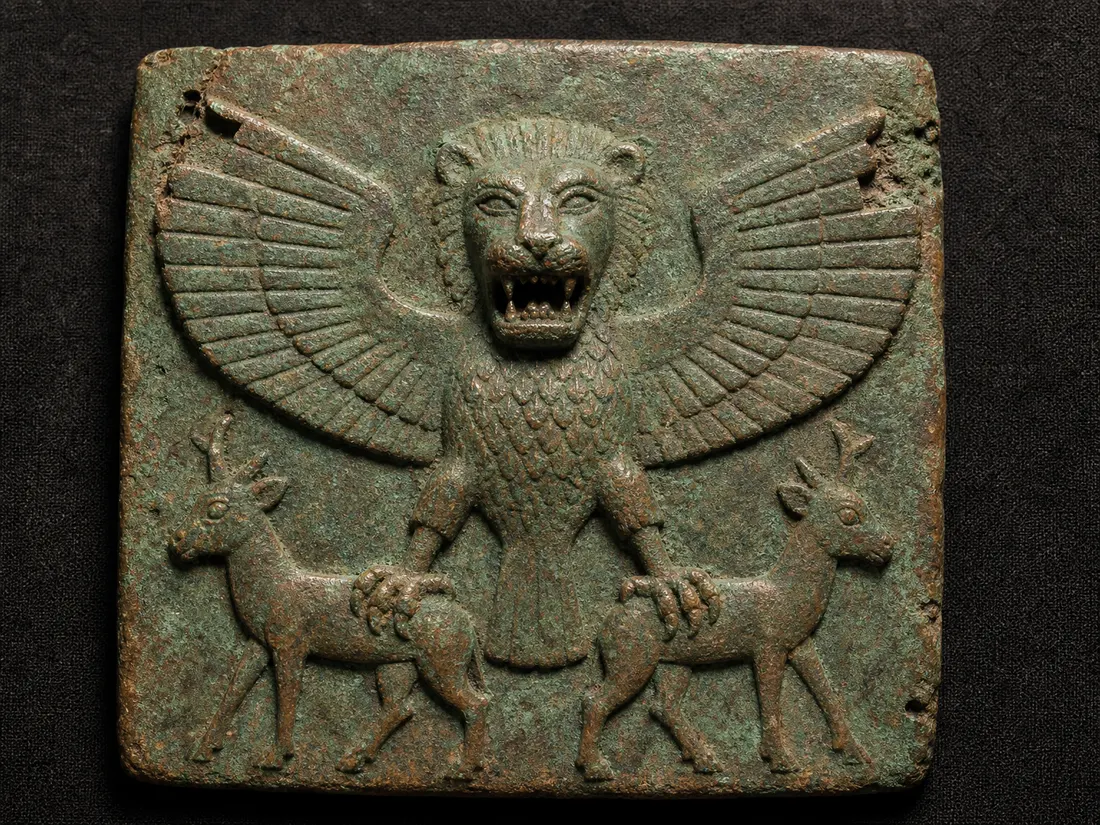
The earliest fully realised winged lion in the record is arguably not a lion with wings but an eagle with a lion's head. Sumerian texts call itImdugud; the Akkadian name, the one that stuck, isAnzû. It is drawn as a great bird seen frontally, wings spread flat to the picture plane, head turned to the side and unmistakably leonine, its talons closed on a pair of animals — stags, ibexes, sometimes lions themselves.
The composition is rigid and it is everywhere: on cylinder seals, stone plaques, votive maceheads, and most famously in copper alloy on temple façades. A relief of this type from the temple at Tell al-Ubaid in southern Iraq, made in the mid-third millennium and now in London, is the canonical example. In its earliest use Imdugud is a benign figure, emblem of the god Ningirsu of Lagash and a signature of divine ownership stamped on temple property.
By the second millennium the character has darkened. The Standard BabylonianAnzû epic, preserved on three tablets, tells of the bird stealing the Tablet of Destinies from Enlil while the god bathes. Possession of the tablet is possession of the decrees that hold the world in order, and the assembled gods decline the commission one after another. Ninurta accepts, and the fight turns on a technicality of magic — Anzû can command the arrows shot at him to return to their component parts — until the hero pins the feathers with wind and cuts the bird's throat. An older Sumerian tradition assigns the deed to Ningirsu and other texts credit Lugalbanda; the myth was told in more than one version.
That trajectory, from divine emblem to defeated chaos-bird, is the first of several reversals in this archive. The image barely changes; what changes is who is telling the story.
The lion of Ishtar and of kings
Behind the hybrid stands the ordinary Mesopotamian lion, which was not a literary abstraction: the Asiatic lion lived in the river marshes into the modern era, and the texts treat it as a practical hazard. Two institutions claimed it. The first is Ishtar — Sumerian Inanna — goddess of sexual power and of war, who stands on a lion, leads one on a leash, or is flanked by them. The second is the king. Royal lion hunts appear from the third millennium onward and reach their most sophisticated treatment in the Neo-Assyrian reliefs of Ashurbanipal at Nineveh, where the hunt is staged, ritual and unmistakably political: the king kills the animal no one else can kill, in public, repeatedly.
The winged lion sits at the intersection of these two claims — the lion's force plus the ability to cross into the divine register, which is exactly what an Assyrian king wanted asserted at his own front door.
The colossi at the gate
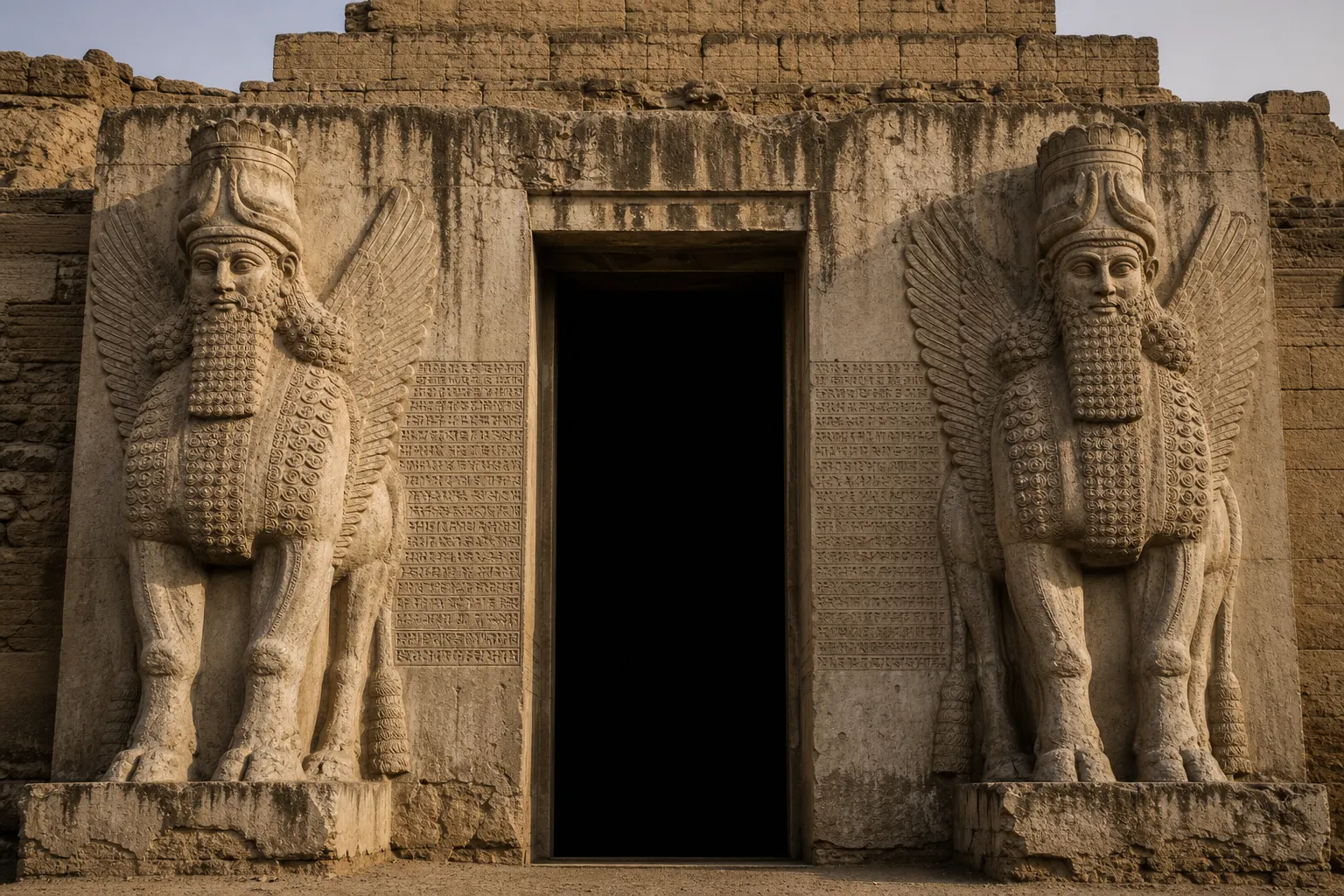
The most familiar Mesopotamian winged lion is the gate colossus: a monumental figure with a bearded human head, a horned crown marking divinity, spread wings and the body of a lion or a bull, cut from a single block of gypsum or limestone weighing tens of tonnes and set into the jambs of palace and city gates. Three building programmes produced most of the survivals — Ashurnasirpal II's Northwest Palace at Nimrud in the ninth century BCE, Sargon II's capital at Dur-Sharrukin (Khorsabad) at the end of the eighth, and Sennacherib's Southwest Palace at Nineveh around 700 BCE.
The gate colossus at a glance
- Names
- Akkadian lamassu and šēdu (protective spirits); aladlammû, a Sumerian-derived term used of the colossi themselves
- Body plan
- Bearded human head with horned crown, bull or lion body, two spread wings, five legs in the standard Assyrian convention
- Where they stood
- Palace doorways, throne-room entrances, city gates and courtyard passages — always in facing pairs
- Function
- Apotropaic: to block hostile forces at the threshold and to announce the king who commanded them
- Chief sites
- Nimrud (Kalhu), Khorsabad (Dur-Sharrukin), Nineveh, Ashur
- Where to see them
- British Museum; Louvre; Metropolitan Museum of Art; Chicago's Institute for the Study of Ancient Cultures, long known as the Oriental Institute
The carving convention is the detail most people remember. Seen head-on the figure stands at rest on two front legs; seen from the side it strides forward on four. The sculptor supplied both readings by cutting five legs, so that a visitor approaching the gate met a static guardian and a visitor walking through it passed a moving one. Not a mistake, and not perspective: two correct views of one body, resolved by addition rather than illusion.
The colossi were also text. At Nimrud the so-called Standard Inscription of Ashurnasirpal II was cut in horizontal bands straight across the surface of relief slabs and, in places, across the flanks and between the legs of the gate figures, so that guardian and royal titulary are physically the same object.
The bodies are bull as often as lion, and both appear in the same building; Ashurnasirpal's palace used each. Any account that treats the bull-bodied version as a separate creature imposes a distinction the Assyrian builders do not seem to have insisted on. The interchange suggests the essential content lay in the combination — human head, wings, massive quadruped body — and that the choice between lion and bull followed workshop tradition or the specific gate.
Lion-griffins and lion-demons
The gate colossus is the public face of a much larger population. Assyrian palaces were protected by a staff of hybrid beings, known from reliefs, from cylinder seals, and from ritual texts that prescribe burying small clay figurines of them under thresholds and floors — a practice archaeology has confirmed by digging the figurines up in their boxes.
- The urmaḫlullû, literally "lion-man": a lion's hindquarters and legs with a human torso, a lion-centaur, associated in the ritual texts with the protection of bathrooms and other vulnerable interior spaces.
- The ugallu, the "great lion" or lion-demon: a standing figure with a lion's head, a human body and a bird's talons, usually armed with dagger and mace, carved beside doorways in the Nineveh palaces.
- The winged lion-griffin, a lion's body with wings and often an eagle's beak, which in Neo-Assyrian art frequently plays the adversary rather than the guard — the creature a god is shown pursuing, a role that echoes the Anzû story.
A threshold has more than one kind of vulnerability, and each was answered with a specific hybrid.
The glazed lions of Babylon
Assyria fell in the late seventh century BCE and the motif's centre of gravity moved south. The Ishtar Gate that Nebuchadnezzar II built carries two animals in moulded, glazed relief: the bull of Adad and themušḫuššu, the scaly dragon of Marduk. The lions belong to the Processional Way that approaches it, where more than a hundred striding lions in white and yellow against a lapis-blue ground walk the visitor towards the gate.
They are wingless, muscular and identical by design — a mould-made frieze produced to a single pattern, manes picked out in contrasting glaze. They belong to Ishtar, and to the same logic as the Assyrian colossi: an approach corridor lined with the animal you cannot argue with. Much of the material was excavated by a German expedition in the early twentieth century and reconstructed in Berlin, with individual lions and dragons distributed to museums elsewhere.
UR.GU.LA: the lion overhead
Mesopotamian astronomy fixed the lion in the sky as firmly as Mesopotamian sculpture fixed it at the gate. Babylonian star lists — the compendium conventionally called MUL.APIN chief among them — name a constellationUR.GU.LA, the Great Lion, occupying the stars we still read as Leo. Within it the lists single out a star in the lion's chest and call it LUGAL, "the King".
That star is Regulus, a diminutive of rex that reaches us through Greek and Arabic intermediaries carrying the Babylonian sense. A four-thousand-year chain runs from a cuneiform star list to the name on a modern chart, transmitting one idea: the heart of the lion is where kingship is located. Palace gate and star list make the same argument in different media.
Tribute, plunder and afterlife
The motif travelled by the ordinary mechanisms of empire. Assyrian campaign accounts record tribute in worked ivory, metal and furniture arriving from the west; excavation at Nimrud recovered thousands of carved ivory pieces, much of it Levantine and Egyptianising in style, stored in palace magazines and thrown down wells. Craftsmen moved as well as objects — deportation was an instrument of Assyrian policy — so workshop conventions crossed borders with the people who knew them. Those ivories are the subject of thenext chapter.
The modern afterlife is a mixed record. Nineteenth-century British and French expeditions moved colossi and relief series to London and Paris in bulk; the British Museum and the Louvre hold the largest groups, with substantial holdings at the Metropolitan Museum of Art and a Khorsabad colossus in Chicago. Those removals preserved the objects and stripped the sites, and both halves of that sentence are true.
In 2015 the Islamic State published video of its members destroying sculpture in the Mosul Museum and at the Nergal Gate at Nineveh, and bulldozed standing remains at Nimrud. The destruction was filmed deliberately, as publicity, and it targeted precisely the figures described here. Some of what was broken was plaster casts; a great deal was not. Documentation, three-dimensional recording and the dispersal of material abroad are now part of why the motif survives at all — uncomfortable to record, and not a reason to stop. The editions and catalogues behind this chapter are listed inSources.