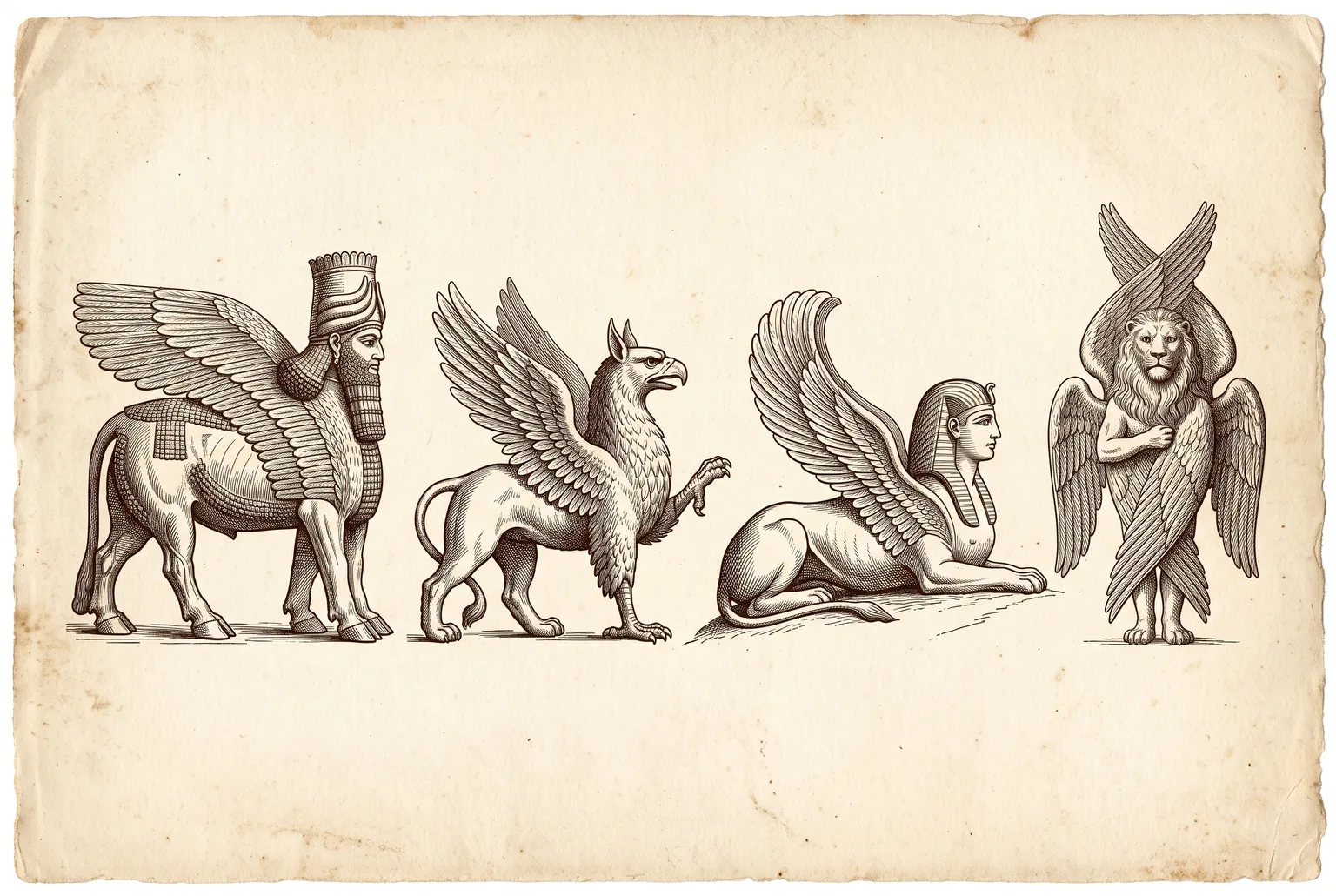
A winged lion is not a fantasy animal. It is an argument made in stone, ivory and bronze, and the argument runs roughly like this: the strongest thing that walks has been given the freedom of the thing that flies, and the result belongs to a different order than either. Every culture in this archive built that sentence out of the same three or four parts, and each one changed the emphasis.
Before the chronology begins, it helps to settle what we are looking at — and to admit how loose the words for it are. Almost every dispute about winged lions in museums and on the internet is really a dispute about naming.
A vocabulary problem
English has inherited four or five names for overlapping creatures, from four different languages, applied inconsistently for two centuries. They are worth separating, because the labels on gallery cases often blur them.
| Name | Head | Body | Wings | Where the word comes from |
|---|---|---|---|---|
| Winged lion | Lion | Lion | Yes | Plain description, no ancient original |
| Griffin | Eagle, beaked, often eared | Lion | Usually | Greek gryps, via Latin |
| Sphinx | Human | Lion | In Levantine and Greek use, yes | Greek, applied later to Egyptian figures |
| Lamassu / aladlammû | Bearded human, crowned | Bull or lion | Yes | Akkadian, and contested as a label |
| Cherub | Human, or four faces | Lion-bodied, quadruped | Yes, two or four | Hebrew kerub |
Two consequences follow. First, a figure can migrate between categories without changing much physically: swap an eagle's head for a bearded human one and a griffin becomes a colossus; give a Levantine sphinx a throne to flank and it becomes a cherub in a biblical description. Second, the ancient names and the modern names do not line up neatly, which is why the Mesopotamia chapter has to be careful about whetherlamassu ever named the gate figure at all.
The parts and what they do
Composite creatures are assembled from a small kit, and each element carries a fairly stable meaning across the ancient Near East and Mediterranean.
- The lion body. Power without appeal, and specifically royal power. The lion is the animal a king hunts to prove himself and the animal a king is compared to; in Mesopotamia it also belongs to Ishtar. A lion body means force that is legitimate.
- The wings. Not flight so much as jurisdiction. Wings mark a figure as belonging to the sky's order rather than the ground's, and in practice they signal that the creature can move between zones — earth and heaven, outside and inside, living and dead.
- The human head. Intelligence, and therefore judgement. A guardian with a human face can assess who is approaching. It is also the element that lets a figure wear a crown, which converts a guardian into a statement about the ruler.
- The eagle head. Vigilance and predatory reach. Eagle-headed hybrids tend to guard property — gold, sanctuaries, thresholds — rather than to preside.
- The horns or crown. Divinity, in Mesopotamian convention, or rank. The horned cap is one of the most reliable indicators that a figure is a god rather than a servant.
The composite in brief
- Core idea
- Earthly strength joined to celestial mobility
- Standard kit
- Lion body, raptor wings, human or eagle head, sometimes horns
- First appearance
- Mesopotamian art of the fourth and third millennia BCE
- Primary use
- Guarding thresholds, thrones, tombs and sanctuaries
- Later use
- Evangelist symbol, civic emblem, alchemical figure
- Not
- A monster in the Greek sense — hybridity marks status, not horror
The grammar of a hybrid
Ancient composites follow rules. They are not arbitrary mash-ups, and the rules are what make them legible at a glance to people who could not read.
Hybridity signals rank, not deformity. This is the point modern eyes most often miss. In a Greek framework a mixed creature can be a horror — the Chimera exists to be killed. In Mesopotamian and Levantine art, combining species is how you depict a being that is more than an animal and other than a person. The hybrid is a grammatical device for "supernatural", roughly as a halo would be later.
Symmetry means ceremony. Single hybrids are rare in architecture. They come in pairs, facing each other across a door, a tree, a throne, or a ruler. The pair creates an axis, and the axis tells you where to walk and where to look. When you find one guardian, the other was almost certainly lost.
Posture encodes the moment. Striding figures are in the act of escorting or advancing; seated and couchant figures are stationed. A raised paw is greeting or blessing in some traditions and warning in others, so posture is read together with context rather than alone.
What it stands on matters. A base, a plinth, a defeated animal, a tree, a wheel — the support is part of the sentence. Nemesis's griffin rests a paw on a wheel; an Etruscan lion crouches at a tomb door; the Venetian lion of a much later age stands on a book.
Four jobs it was given
Across three thousand years and a dozen cultures, the winged lion is repeatedly hired for the same four purposes.
- Guarding a threshold. City gates, palace doorways, temple entrances. The Assyrian colossi are the fullest expression, and their logic is preventive: they absorb hostile forces before those reach the door. SeeMesopotamia.
- Supporting or flanking a throne. The ruler seated between two winged lion-bodied creatures is one of the most durable political images ever invented, running from Canaanite ivories to the cherub-throne of the Jerusalem temple. See The Levant.
- Guarding the dead and the valuable. Tomb doors in Etruria, sanctuary treasuries and northern gold in Greek report. SeeGreece and Etruria & Rome.
- Standing for something. Late in the sequence the creature stops guarding and starts representing: an evangelist, a city, a principle. SeeChristian Tradition andEsoteric Meanings.
How to read one you meet
In a gallery, on a church façade, over a bank's doorway, six questions will place almost any winged lion within a century or two and tell you what it was for.
- What is the head? Human, eagle, or lion — that decides the family.
- How are the wings attached and shaped? Stiff, upswept and feather-tiered suggests Near Eastern convention; anatomically hinged and mobile suggests Greek or later work.
- Is it a pair? If yes, look for the axis between them and ask what stood there.
- What is beneath the paws? Plinth, prey, wheel, book, or nothing.
- Is there text? Inscriptions cut across a body are an Assyrian habit; an open book with a Latin motto is a Venetian one.
- Where is it placed? Threshold, tomb, throne, roofline, or coin. Placement is the strongest single clue to function.
How the motif travelled
The transmission is not mysterious, and it is not a matter of shared dreams. It moved through three concrete mechanisms: trade in small portable objects, above all carved ivory panels and engraved seals, which functioned as pattern books;tribute and plunder, which relocated whole workshops and their craftsmen into Assyrian palaces; and the movement of artisansthemselves, deported, hired or migrating. A motif on an ivory plaque in a Phoenician workshop can appear on a Greek bronze within a generation because someone carried the plaque.
The chronology in this archive follows that route: invention in Mesopotamia, adaptation in the Levant, transformation in the Aegean, funerary specialisation in Italy, and conversion into a symbol under Christianity. The sky runs alongside it. Babylonian star lists already knew a Great Lion, and a king-star in its chest — the thread picked up inRegulus and Leo.
Using this archive
Each chapter is self-contained and roughly a fifteen-minute read, with its own contents rail. Boxes are colour-coded on purpose: grey for notes and quoted sources, red-edged for contested ground where scholars disagree, gold for symbolic and esoteric readings that belong to a tradition rather than to the evidence. The distinction is maintained throughout, and the reasoning behind it — along with the reading list and a plain note about the interpretive nature of the illustrations — is set out inSources & Further Reading.
The chronology starts at the beginning: Mesopotamia, the first winged lions.