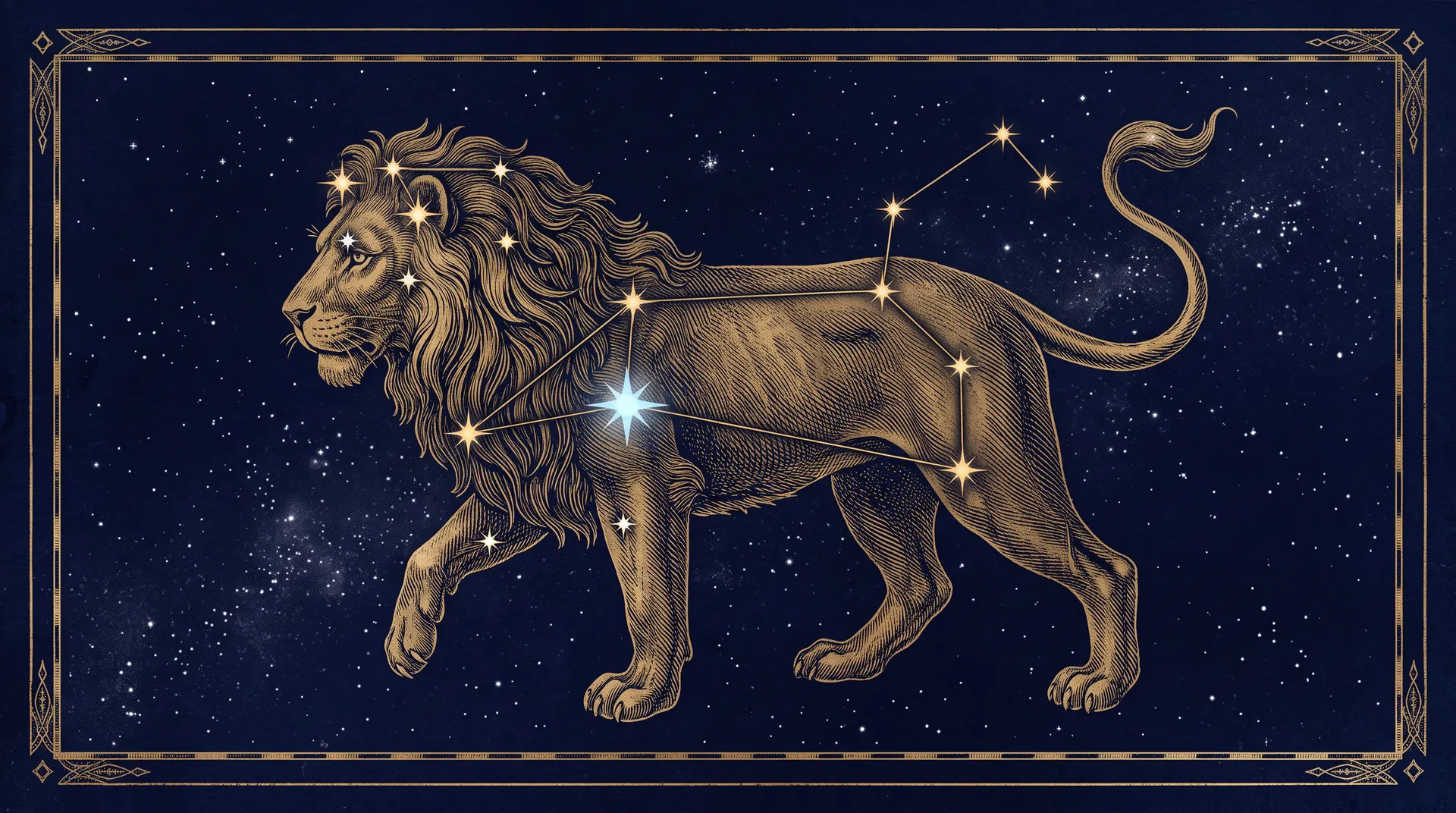
Regulus is the brightest star of Leo and one of the two dozen or so brightest in the sky, but its long career in symbolism rests less on brightness than on position. It lies within roughly half a degree of the ecliptic, the line the Sun traces through the year, so the Moon crosses it and the planets graze it as they can with no other star of comparable rank. The oldest recorded names for it call it the king; the Arabic name places it at the heart of the lion.
What the star is
Regulus is Alpha Leonis. Its apparent magnitude is approximately 1.4, which puts it just inside the group conventionally called first magnitude and makes it the faintest member of that group. Parallax places it at approximately 79 light years, about 24 parsecs — a well-established figure, but one to read as an approximation with a margin attached.
The star the eye sees is hot and blue-white. Catalogues class the primary as a B-type star near the end of the main sequence, with published types clustering around B7 and B8; its surface runs several times hotter than the Sun's and it radiates on the order of a few hundred times the Sun's light, much of it in the ultraviolet. Mass estimates put it at roughly three to four solar masses, and a star of that mass burns quickly, so Regulus is young — a few hundred million years old, against the Sun's four and a half billion.
Regulus at a glance
- Designation
- Alpha Leonis (α Leo); Cor Leonis in older European usage
- Apparent magnitude
- Approximately 1.4 — the brightest star in Leo
- Distance
- Approximately 79 light years, about 24 parsecs
- System
- At least four stars: a bright primary with a close unseen companion, plus a distant faint pair
- Spectral type
- Blue-white B-type primary, usually catalogued around B7–B8
- Position
- Within about half a degree of the ecliptic — closer to the Sun's path than any other star of its brightness
Spinning close to break-up
Two things make Regulus unusual as an object rather than as a symbol. The first is that it is not one star. The bright primary has a close companion detected from the periodic shifting of its spectral lines, orbiting in something like forty days; it is not seen directly, and the standard interpretation is a low-mass white dwarf — the stripped core of a star that has already finished burning, which probably spun the primary up by dumping matter onto it. Far outside that pair, at a separation of a few thousand times the Earth–Sun distance, sits a faint orange dwarf with a fainter red dwarf beside it, together around eighth magnitude. All four share a common motion through space, which is why they are treated as one physical system rather than a chance alignment.
The second is the rotation. The Sun turns once in about twenty-five days at its equator. Regulus turns once in something like sixteen hours, at an equatorial speed measured in hundreds of kilometres per second. That is a large fraction of its break-up speed — the rate at which material at the equator would be flung off rather than held down by gravity. Published estimates put it somewhere in the region of eighty to ninety-five per cent of that limit.
Half a degree from the ecliptic
The ecliptic is the plane of Earth's orbit projected onto the sky, and so the track the Sun appears to follow through the year. The Moon and planets never stray far from it. Regulus sits about half a degree north of it — roughly the width of the full Moon — closer to the Sun's path than any other star of its brightness, and that accident of position is the root of everything the star later accumulated.
In practice, the Moon regularly passes in front of it. Because the plane of the lunar orbit rotates on a cycle of about 18.6 years, these occultations come in seasons: a run of them across a year or two, then several years without. The Sun itself passes within about a degree of the star each year around 22 or 23 August, which is why Regulus is unobservable for a few weeks in late summer. Planetary occultations are rare — Venus in 1959 is the modern instance usually cited, and the next is not expected until the middle of this century.
The same position made the star useful to the astronomers who compiled the first catalogues. Celestial longitude is measured along the ecliptic, and a bright star sitting almost exactly on that line, frequently occulted by the Moon, makes an ideal fixed reference for tying lunar and planetary positions to the stellar frame. Regulus is one of the standard reference stars of theAlmagest catalogue, whose material rests substantially on Hipparchus — and it was Hipparchus, comparing measured stellar longitudes against those recorded by earlier observers, who identified precession, the slow slide of the equinox point along the ecliptic. Exactly which comparisons carried that argument, and how precise the ancient figures were, are questions the surviving evidence leaves open.
The names of the star
The names fall into two families. The first calls the star a king. In the Babylonian star lists it appears as LUGAL, the Sumerian word for king, placed in the breast of the Great Lion,UR.GU.LA. Greek astronomy inherited both figure and epithet: Ptolemy's catalogue in the Almagest describes the star on the heart as the one called Basiliskos, the little king. Latin rendered that diminutive asRegulus, the form Copernicus used and the one that became standard.
The second family calls it a heart. Arabic astronomy knew it asQalb al-Asad, the heart of the lion, which reached medieval Europe through the Latin translations of Arabic works both asCor Leonis and in a scatter of garbled transliterations.Cor Leonis stayed in common European use into the early modern period, long enough that many Renaissance charts label the star that way.
It is worth being exact about what this agreement shows. It is not several cultures independently inventing a royal star. It is one idea travelling a documented chain — cuneiform star lists to Greek, Greek to Arabic, both back into Latin — with each language translating the epithet it received. The recurrence is evidence of contact, not of convergence.
Indian astronomy divides the ecliptic into lunar mansions rather than signs, and Regulus is the principal star of the mansionMagha, which the tradition associates with a throne and with the ancestors. Magha names the group, not the single star.
The four royal stars
Regulus is routinely listed as one of four royal stars, spread roughly ninety degrees apart and described as watchers of the four quarters. In the third millennium BCE the four lay near enough to the equinoctial and solstitial points to work as rough seasonal markers; precession has since pulled all of them away. The quarter assignments below are given as modern sources usually give them, and modern sources do not entirely agree with each other — which is itself a clue about the scheme's origin.
| Star | Constellation | Quarter in the modern scheme | Approx. magnitude |
|---|---|---|---|
| Aldebaran | Taurus | East, or the spring equinox | About 0.9, slightly variable |
| Regulus | Leo | North, or the summer solstice | About 1.4 |
| Antares | Scorpius | West, or the autumn equinox | About 1.0, noticeably variable |
| Fomalhaut | Piscis Austrinus | South, or the winter solstice | About 1.2 |
The star of kings
Regulus is a heavyweight of the fixed-star tradition, and the reason is again positional: a star half a degree from the ecliptic is a star that planets conjoin exactly, which in a system built on conjunctions makes it unavoidable. Ptolemy's Tetrabiblos assigns the star on the lion's heart the combined temperament of Mars and Jupiter, and the later tradition read that pairing as the signature of high office.
Arabic astrological writing and its Latin heirs carried the star forward as an indicator of honour, ambition and the favour of the powerful. It appears among the fifteen Behenian fixed stars of the Hermetic talismanic tradition tabulated by Renaissance writers, each star paired with a stone, a plant and an engraved sigil. The qualification most often quoted today — that the honour Regulus confers is lost if the native takes revenge — belongs to twentieth-century compilations, not to the ancient material.
One modern fact belongs here, correctly framed. The tropical zodiac is measured from the vernal equinox point rather than from the stars, and precession slides that point westward at roughly one degree every seventy-two years. The stars therefore drift forward through tropical longitude, and Regulus crossed from the last degree of tropical Leo into the first degree of tropical Virgo around 2012. Nothing happened to the star. A coordinate boundary moved past it, and the fact is calendrical, not physical.
Finding Regulus
Leo's head and mane form the Sickle, six stars in a backwards question mark. Regulus is the dot at the bottom of that question mark — the base of the Sickle. Once the shape is recognised the star cannot be mistaken, since nothing near it approaches its brightness.
For northern observers the reliable route is the Big Dipper. The two stars at the outer end of the bowl, Dubhe and Merak, are the pointers: followed north they reach Polaris, and followed the other way, south, the same line runs down to Regulus. The old mnemonic is that a hole punched in the bottom of the bowl would drip onto the lion.
The star rises in the east on late-winter evenings, stands highest around local midnight in late February and early March, and is well placed in the early evening through April and May. It is lost in the Sun's glare for several weeks around late August and returns as a morning object in autumn. Its colour is a genuine blue-white, easiest to judge when a yellowish Saturn or a red Mars passes nearby — which, given its place on the ecliptic, they regularly do.
The heart of the lion
The naming closes a circle that runs through the rest of this archive. The lion carved beside an Assyrian palace gate and the lion drawn across the spring sky are the same royal animal, described within the same royal ideology: the star lists that call Regulus the King and the reliefs that put winged lions at the doors of the king's palace come out of one scribal and courtly world. That is a weaker claim than saying the sculptors were carving the constellation, and it is the one the evidence supports. The gate itself is treated in the Mesopotamian chapter.
What the Arabic name adds is anatomy. Putting the brightest star at the lion's heart locates royal power in a body, at the organ that later systems of correspondence assign to the Sun and to gold. When the esoteric literature calls Regulus the heart of the heart it is stacking that association on itself; that reading is set out, and labelled as a reading, in the chapter on esoteric meanings. For the constellation the star belongs to, see Leo.