Greece did not invent the winged lion. It received one, in quantity, over about three generations, and then rebuilt it. What arrives from theLevantine and North Syrian workshops in the seventh century BCE is a heraldic sign; what leaves Greek hands two centuries later is an animal with muscles, a temper and a job. The two creatures that carry the motif in Greek art - the eagle-headed gryps and the woman-headedsphinx - are kept firmly distinct, and the distinction holds for a thousand years.
The orientalising channel
Between roughly 725 and 630 BCE, Phoenician and North Syrian goods reach the Aegean in bulk: engraved bronze bowls, carved ivory plaques and furniture fittings, faience, seals, patterned textiles. They land first where the trade routes land - Crete, Rhodes, Samos, Cyprus - and the workshops that copy them hardest are Corinthian, Cretan and East Greek. The imported repertoire brings the whole eastern menagerie with it: sacred trees flanked by beasts, lion-griffins, human-headed winged sphinxes, files of striding lions of the kind already established atthe Assyrian palace gates.
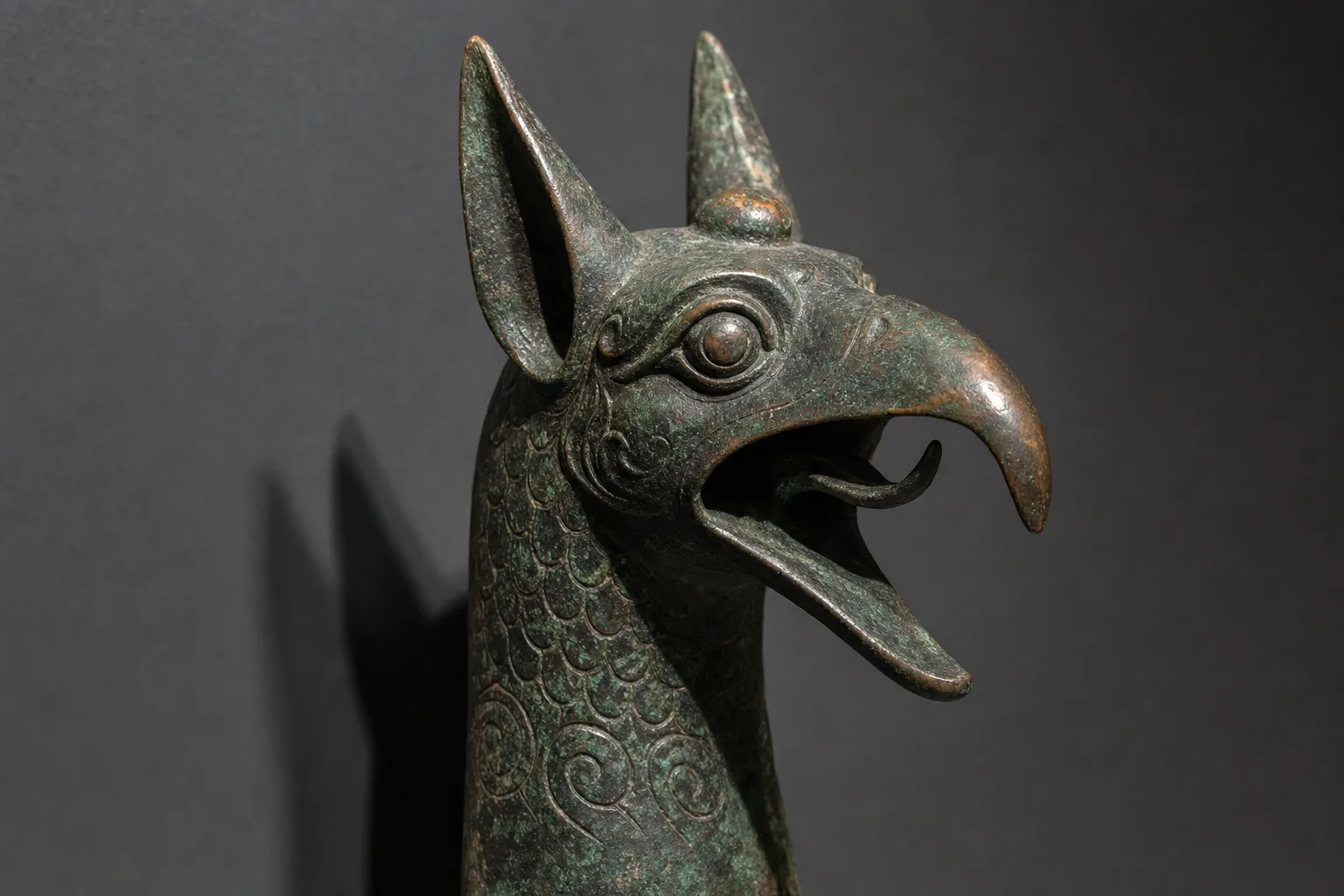
Greek craftsmen change three things, and the changes are consistent enough to be diagnostic. First, anatomical logic: the shoulder where wing meets body is worked out rather than asserted, the haunch is given a real joint, the ribcage is modelled. Second,dynamism: the eastern hybrid is usually a symmetrical emblem, calm and frontal, while the Greek one lunges, rears, screams or stalks - it becomes a participant in a scene instead of a badge on a wall. Third, a standard head. The Greek griffin gets a raptor's hooked beak held wide open with the tongue raised, two long upright ears like a donkey's, and a knob or spiral boss on the crown of the skull. That knob has no obvious Near Eastern parallel and no explanation in the texts; it is simply the mark by which a Greek griffin is recognised.
Cauldron protomes at Olympia and Samos
The type-object of the whole transfer is a bronze griffin head on a long, curving, snake-like neck, riveted to the rim of a cauldron. The cauldron itself - a wide bronze lebes set on a conical stand or a tripod - was a prestige dedication, and the protomes stood up around its lip facing outward, three or four or six to a vessel, so that the offering looked back at anyone approaching it. Fragments of these survive in the hundreds from the sanctuary of Zeus at Olympia and from the Heraion on Samos, with further examples from Delphi, Rhodes and the East Greek sanctuaries.
The series has an internal chronology that can be read off the technique. The earlier heads are hammered from sheet bronze and assembled, with the ears, knob and eye inlays added separately; the later ones are cast solid by the lost-wax method, which allows crisper scales on the neck, a heavier beak and a more aggressive set to the head. The cast series is generally placed in the later seventh and early sixth centuries. Whether the idea of attaching animal protomes to cauldron rims came to Greece from Urartian and North Syrian metalwork, where comparable bull and siren attachments occur, or whether Greek smiths developed the griffin version independently from imported flat imagery, is still argued; the eastern cauldron attachments are demonstrably related but not obviously ancestral in a straight line.
The Greek griffin and sphinx at a glance
- Greek names
- gryps, plural grypes, the eagle-headed lion; sphinx, plural sphinges, the woman-headed lion. Hesiod uses the Boeotian form Phix for the Theban monster.
- Body plan
- Lion body, haunches and tail throughout. The griffin adds an eagle head with open hooked beak, upright pointed ears and a knob on the crown; the sphinx keeps a woman's head and, unlike the Egyptian type, is always winged in Greek art.
- Typical objects
- Cast and hammered bronze cauldron protomes, grave stele finials, votive columns, black-figure and red-figure vases, gold earrings and pendants, civic coin types, Hellenistic mosaic panels.
- Sanctuaries and sites
- Olympia, the Heraion of Samos, Delphi, Rhamnous in Attica, the Attic cemeteries, and the Cretan and Rhodian workshops that took the first imports.
- What it guards
- Gold at the northern edge of the world, the sanctuary and its dedications, the tripod and the throne, and - for the sphinx above all - the grave and the person in it.
- Where to see it
- The archaeological museums at Olympia, Samos, Delphi and Athens hold the primary material; the British Museum and the Metropolitan Museum of Art hold substantial comparative collections.
Aristeas, the Arimaspians and the gold
The literary griffin is a northern animal and a mining animal, and it enters Greek writing through a poem that no longer exists. Aristeas of Proconnesus, a semi-legendary figure of the seventh or sixth century BCE, was credited with a hexameter travel poem called the Arimaspea, describing peoples progressively further north and east: the Issedones, then the one-eyed Arimaspians, then the gold-guarding griffins beyond them. The poem survives only in quotation and report. Herodotus, who is the main report, treats the chain of informants as exactly that - a chain, each link claiming to have it from the next - and declines to vouch for it.
The tragic stage keeps the creature dangerous. In Prometheus Bound, transmitted under the name of Aeschylus though the attribution is now disputed, Prometheus warns Io away from "the sharp-beaked hounds of Zeus that do not bark" and from the one-eyed horsemen who live beside them. The phrase fixes two ideas that stay attached to the griffin for centuries: it belongs to a god, and it is a pack animal rather than a monster acting alone. Later prose writers keep the gold and lose the poetry. Pliny the Elder mentions the long-eared, hook-beaked griffin among the marvels he reports with visible scepticism; Aelian, writing in Greek on animals, relocates the whole scenario to India and describes griffins digging gold and fighting off anyone who comes for it.
Apollo, Nemesis and the wheel
Two deities keep griffins in Greek practice. Apollo's claim runs through the north: the god winters among the Hyperboreans, the Hyperborean north is where the gold and the griffins are, and griffins accordingly flank him, draw him, or sit beside his tripod. Fourth-century South Italian vase painters like the image of Apollo riding a griffin, and griffin heads decorate tripods and tripod-cauldrons, which are Apollo's dedication above all others.
Nemesis, the measurer who cuts down whatever grows past its allotment, acquires the griffin as her attribute animal along with the wheel - the wheel of retribution that turns everything back to its proper size. Her principal Attic sanctuary was at Rhamnous. The specific formula ofNemesis with one foot or hand on a wheel, the griffin beside or below it, sometimes drawing her chariot, is best attested in Hellenistic and Roman-period images, including provincial reliefs and gems, rather than in the Archaic material; the association of goddess, griffin and wheel hardened over time rather than arriving complete. The logic is consistent with the griffin's other work: a creature that keeps gold from those who reach for it is a natural servant of the power that punishes overreach.
The Sphinx: female, Theban, funerary
The Greek sphinx is not a variant griffin and not the Egyptian sphinx either. She is female, she is always winged, and her head is a woman's, worn with the hairstyles of the period - which makes Archaic sphinxes datable by coiffure. Hesiod, listing the monstrous brood of Echidna's line, calls herPhix, a deadly thing sent against the Cadmeans; the Greeks themselves connected the later name to the verb meaning to squeeze or throttle, though that is probably folk etymology and a non-Greek origin for the word has often been proposed.
She does three jobs. As the Theban riddler she sits on a rock outside the city, puts a question to travellers and kills those who fail it, until Oedipus answers and she destroys herself. It is worth noting that the famous riddle - what goes on four legs, then two, then three - is not given in the earliest surviving accounts; the fifth-century tragedians treat the encounter as known and allude to her as the singer of a dark song without spelling out her question. As a funerary marker she crowns Archaic Attic grave stelai, seated upright on the shaft above the dead man's image, watching the road; the same period sets her on votive columns, the tallest surviving example being the Naxian sphinx at Delphi, perched on a fluted Ionic column of the mid sixth century and now displayed in the site museum there. As a snatcher she appears in vase painting standing over or carrying off a limp youth - the death that takes the young out of the city, given a body.
Griffin, sphinx, winged lion
Greek usage keeps the three apart with unusual discipline. The plain winged lion - lion head, lion body, wings, no other borrowing - is the rarest of the three in Greek art proper, most at home on imported and eastern-influenced objects and on the fringes of the Greek world, where it stays closer to its Mesopotamian andLevantine ancestors.
| Creature | Head | Sex | Where it appears | What it does |
|---|---|---|---|---|
| Gryps (griffin) | Eagle, open beak, upright ears, forehead knob | Not marked; treated as male | Cauldron protomes, tripods, armour, coins, vase combat scenes | Guards gold and sanctuary property; hunts; serves Apollo and Nemesis |
| Sphinx | Woman, often with contemporary hairstyle | Female, explicitly | Grave stelai, votive columns, furniture, vases, mirror handles | Guards and marks the tomb; riddles; snatches the dead |
| Winged lion | Lion | Usually male, maned | Imports, East Greek and colonial work, seals, jewellery | Retains the eastern guardian and throne-bearer role |
Combat scenes and eastern gold
From the late fifth century the griffin becomes a fighter. Attic red-figure of the fourth century, much of it exported to the northern Black Sea, and the South Italian workshops both take up the theme of griffins battling mounted Amazons, or griffins battling the Arimaspians in their trousers and pointed caps. The same subject appears worked in gold on objects buried in the great steppe tombs, where the metal and the imagery met their intended audience.
That is not a coincidence of taste. The Greek cities on the Black Sea coast were the interface between Aegean workshops and the nomadic north, and the gold in question moved along routes reaching towards Central Asia. The griffin-and-gold story and the griffin-versus-horseman image belong to the same commercial world. The steppe side of that exchange - the gold plaques, the animal style, the Altai burials - deserves its own chapter and is not covered here.
Hellenistic griffins and the Roman inheritance
After Alexander, the griffin becomes an ornament as much as an actor. It appears in figured mosaic pavements, as pairs of confronted beasts framing a vessel or a candelabrum; as griffin-head finials on hoop earrings and torcs, one of the standard products of Hellenistic goldsmithing; and as a civic emblem on coinage, where the griffin is the badge of Teos and of Abdera, its Aegean colony, and appears in the coin types of the Bosporan capital Panticapaeum. Furniture legs terminate in griffin heads and lion paws, and the combination of hybrid beast, scrolling plant and central support becomes a portable decorative grammar.
That grammar, and the word itself, pass to Rome: Latingryphus is the Greek grypswith a Latin ending, and the Roman marble carvers inherit the confronted pairs, the candelabrum between them and the association with Apollo intact. What Rome and Etruria do with the inheritance - and how a sanctuary guardian becomes a tomb guardian at industrial scale - is the subject ofthe next chapter.