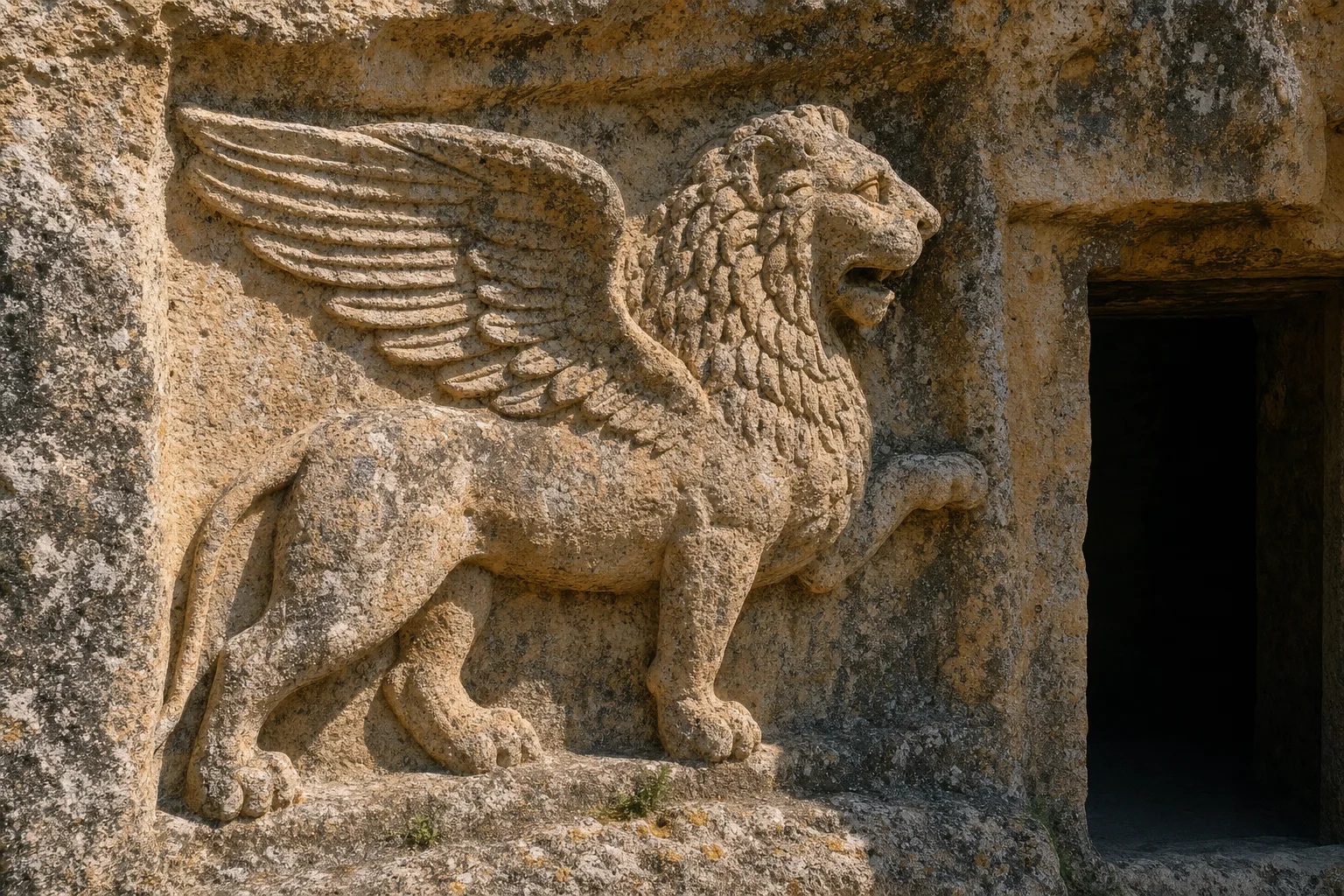
Italy took the hybrid and pointed it at death. InGreece the griffin guards gold and sanctuary property and the sphinx sits on a grave; in Etruria the whole family migrates into the necropolis and stays there. Winged lions flank the cut doorways of rock tombs, crouch at the ends of sarcophagus lids and stalk across the painted walls of burial chambers, and when Rome inherits the repertoire it keeps both halves: the beast as ornament on public marble, and the beast as the thing standing between the living and the dead.
An Etruscan appetite for eastern beasts
The Etruscan orientalising period runs through the seventh century BCE and is driven by metal. Etruria had copper and iron; Phoenician, Cypriot, North Syrian and East Greek traders had bronze bowls, ivories, ostrich eggs, faience and gold, and the exchange fills the princely tombs of Cerveteri, Vulci, Vetulonia and neighbouring Praeneste with the entire eastern bestiary in miniature. Granulated gold fibulae carry rows of tiny lions; ivory pyxides and bone plaques carry sphinxes beside sacred trees of a type already standard in Levantine workshops.
Etruscan artists absorbed the beasts quickly and then specialised them. In the Near East the winged lion belongs at the palace gate; in Etruria it belongs at the tomb. That shift is the single most consequential thing that happens to the motif in Italy, because it is the Etruscan-Roman funerary version - not the Assyrian palace version - that Christian workshops later had ready to hand.
The Italian winged lion at a glance
- Names
- Latin gryps or gryphus for the eagle-headed beast, sphinx for the woman-headed one, leo alatus for the plain winged lion. Etruscan names for these creatures are not securely recorded; the labels in use are Greek and Latin ones.
- Body plan
- Lion body with feathered wings, either lion-headed or eagle-headed. Etruscan versions often add a long snake-like tail or a fish tail; Roman decorative griffins are slender, high-shouldered and paired heraldically.
- Where it appears
- Rock-cut tomb facades, nenfro and tufa guardian statues, painted tomb chambers, ash urns and sarcophagi; then Roman marble friezes, altars, cuirass reliefs, table supports, candelabra and mosaic borders.
- Function
- Threshold guardian of the grave, escort on the journey to the underworld, attribute of Apollo and of Nemesis, and a mark of imperial and sacral decorum on public monuments.
- Chief sites
- Vulci, Tarquinia, Cerveteri, Chiusi and Arezzo in Etruria; Rome, Ostia and the Campanian towns; amphitheatre shrines in the Danubian and western provinces.
- Where to see it
- The Museo Archeologico Nazionale in Florence holds the Chimera of Arezzo; the Villa Giulia and the Vatican museums in Rome hold Etruscan tomb sculpture; the necropoleis of Cerveteri and Tarquinia can be visited directly.
Guardians at the tomb door
The Etruscan cemeteries are cities in their own right: streets of tumuli at Cerveteri, rock-cut facades at Norchia and Castel d'Asso, painted chambers at Tarquinia, carved cippi and alabaster urns at Chiusi. Vulci in particular produced a long series of guardian animals carved innenfro, the soft dark volcanic stone of the region - winged lions, sphinxes and centaurs, roughly life-sized, set in pairs at the entrances to tomb precincts. They are weathered now, and many were removed from their findspots early, which is why examples are scattered across Italian and foreign collections rather than standing where they were meant to stand.
The logic is the same logic as the palace gate, transposed. A door in a hillside is a hole in the boundary between two conditions; something has to hold it. The Etruscan version is more anxious than the Assyrian one, because Etruscan funerary art takes the journey seriously as a journey, with demons - the hammer-bearing Charun, the winged Vanth with her torch - as escorts and officials rather than decoration. The winged lion is the animal member of that staff. On sarcophagus chests and urn fronts the same beasts appear in profile friezes, often confronted across a vase or a plant, and they are doing at small scale what the nenfro pairs do at the tomb mouth.
The Chimera of Arezzo
The most technically ambitious Etruscan hybrid is not a winged lion, and the difference is instructive. The bronze Chimera found at Arezzo in the sixteenth century - now in Florence - is a lion in agony and fury: ribs and hip bones showing through the hide, mane worked as a row of separately articulated flames, a goat's head erupting from the spine and bleeding from a wound, the tail a serpent that rears to bite. An inscription on the right foreleg reads TINSCVIL, marking the object as a dedication belonging to Tinia, the chief Etruscan god. It is conventionally dated to around 400 BCE.
It has no wings. What it demonstrates is the level of anatomical observation and lost-wax casting available to Etruscan bronzeworkers at the moment when the winged lion was in their repertoire, and it shows the Etruscan preference for a hybrid that is in pain and in motion rather than heraldically composed. When the same workshops produce griffins and winged lions, they bring that muscle and that snarl with them.
Sea-griffins and the journey out
Etruscan and, later, Roman funerary art is full of animals that end in water. The hippocampus - horse in front, fish behind - is the commonest, but the same treatment is given to lions, griffins and bulls, producing the sea-griffin and the sea-lion that swim across sarcophagus fronts, urn panels and painted tomb friezes among tritons and nereids. On painted Tarquinian walls and on carved chests the marine procession sits directly beneath or beside scenes of the funeral banquet.
The usual reading is that the sea stands for the crossing to the other world and the fish-tailed beasts are the transport or the escort. That reading is reasonable and old, but it is a reading: Etruscan religion is known to us mostly through Greek and Roman intermediaries and through images without captions, and marine ornament also had a straightforward decorative life on objects that had nothing to do with death. The safe statement is that the sea-griffin belongs to the same funerary visual vocabulary as the tomb-door lion, not that every fish-tailed lion is a theological proposition.
Rome: the griffin as decorative order
Rome industrialises the motif. From the late Republic onward, the griffin becomes one of the standard elements of an architectural and funerary ornament system: two beasts confronted or addorsed, a candelabrum, vase or plant between them, framed by acanthus scroll. It runs along marble friezes and altar sides, around the drums of decorative columns, across Campana terracotta plaques on public and private buildings, and through the borders of mosaic pavements. Because the pairing is symmetrical and modular, it scales to any length of frieze - which is precisely why it is everywhere.
Two associations keep it dignified rather than merely pretty. The first is Apollo, inherited intact from Greek practice: the griffin is Apollo's beast, and Augustan monuments connected with Apollo - above all the Palatine temple complex the emperor built beside his own house - use the Apolline repertoire heavily. The second is the martial one. Cuirassed statues carry hybrids on the breastplate and shoulder-flaps: the Augustus from Prima Porta has sphinxes on its shoulder-pieces, and griffins appear in the same position on other imperial cuirasses, marking the wearer's armour as a cosmological surface rather than just protective plate.
The griffin also becomes furniture. Marble table supports carved as a griffin's head, wing and paw, bronze couch fittings with griffin protomes, and candelabra with lion-paw feet are standard high-end domestic goods in Rome, Pompeii and Herculaneum. A creature that guarded gold at the edge of the world spends the Empire holding up a side table - and that domestication is exactly what keeps the form alive and available for later reuse.
Nemesis-Fortuna and the provincial wheel
The one place where the Roman griffin keeps real religious force is in the cult of Nemesis, increasingly fused with Fortuna. The goddess appears with her wheel, and the griffin sits beside it or rests a forepaw on it: the wheel turns, the beast holds it, and what rose comes down. Dedications to Nemesis cluster around amphitheatres, where small shrines stood by the arena entrances and where the people making the dedications - gladiators, beast-fighters, the officials who ran the games - had an unusually direct interest in the turning of luck. The pattern is well attested in the Danubian provinces and in the western provinces generally.
The lion-headed god of the mysteries
In the mithraea - the small, deliberately cave-like halls of the cult of Mithras, spread through the army and the ports from the later first century CE - there stands a figure that has never been satisfactorily named. A human body, upright, usually nude or lightly draped, with alion's head; a serpent coiled around the body from feet to crown, its head resting on or over the lion's skull; commonly a pair or two pairs of wings; and in the hands keys, a sceptre or a staff. Some examples carry the signs of the zodiac on the body, a globe or a band crossed diagonally, or torches; some stand on a globe.
Worth noting alongside it: the cult's seven grades of initiation included one called Leo, the Lion, associated with fire and subject to purification by honey rather than water. The lion is inside Mithraism at the level of human rank as well as divine image.
Arena, tomb and handover
Rome also knew the lion as a literal animal, imported in quantity for thevenationes and understood as the standard instrument of a public death. That experience feeds the funerary imagery: Roman sarcophagi carry lions savaging horses, boars and stags, and lion heads appear as spouts, handles and corner masks on tombs and basins. The lion on a tomb is not only a guardian - it is also the thing that took the life, kept where it can be seen.
By the fourth century CE the workshops cutting these sarcophagi were taking Christian commissions from the same stock of patterns, the same drills and the same carvers. A winged lion at a threshold was already an entirely normal thing to carve, already associated with death, guardianship and the sacred, and already stripped by four centuries of ornamental use of any specific pagan cult attachment. It cost a Christian workshop nothing to accept the form and give it a new referent - an evangelist, a gospel, an open book. That reassignment is the subject ofthe following chapter.