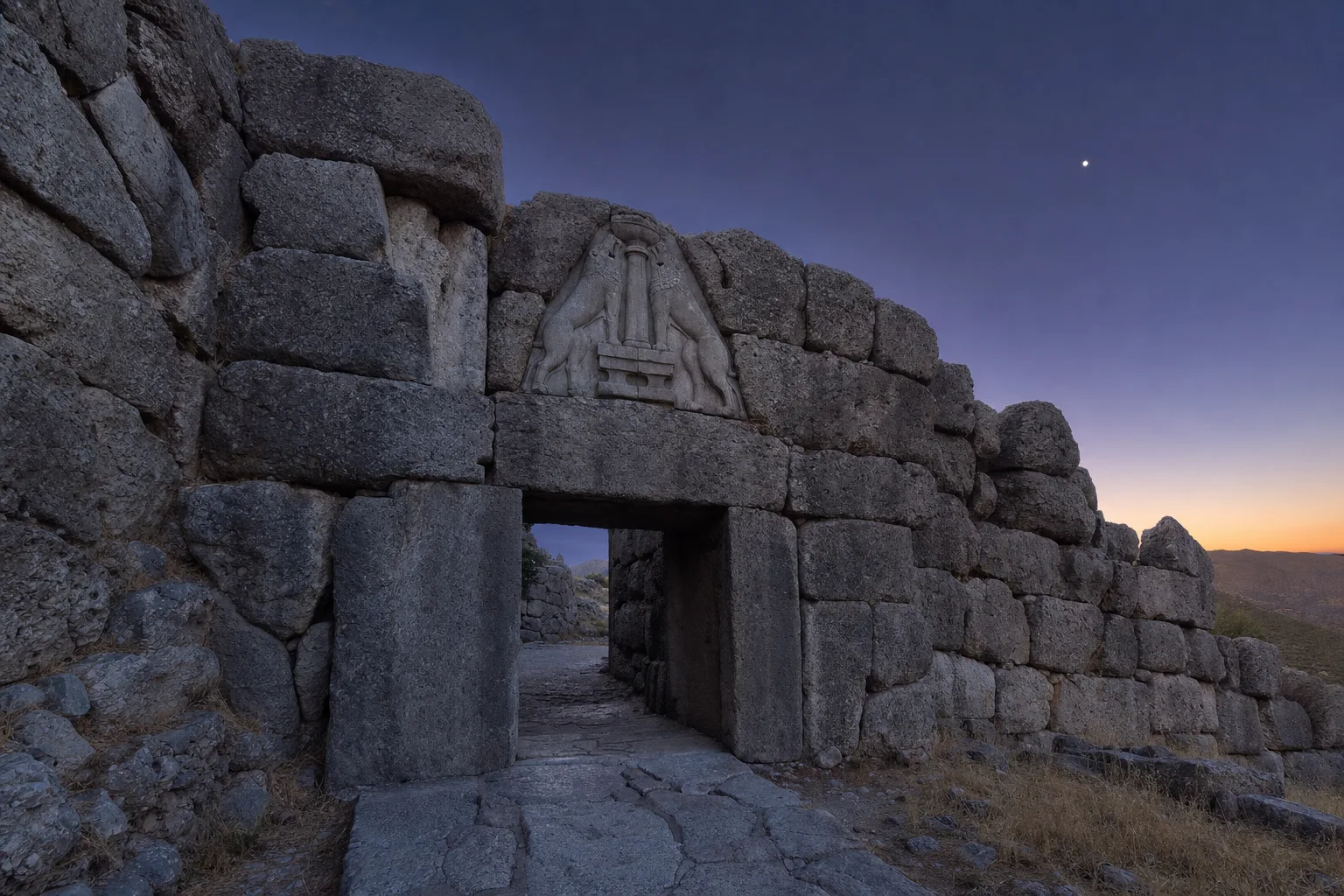
Three quite different things are called the Lion's Gate, and they have almost nothing to do with one another. One is a gateway of stone in the Peloponnese, built when Mycenae was a power and standing still. One is an event in the sky: the morning on which Sirius, the brightest star in the night, returns from beneath the Sun's glare — the event that once opened the Egyptian year. The third is a date, the eighth of August, kept in contemporary practice as a doorway that opens and closes. This chapter takes them one at a time, because the interesting thing is not that they share a name but why the same image keeps arriving at every threshold.
The gate of stone
Mycenae sits on a low hill in the Argolid, in the north-east Peloponnese, between two ravines with a view down the plain towards the sea. Its citadel was walled in the fourteenth and thirteenth centuries BCE with blocks so large that later Greeks could not credit human builders and assigned the work to the Cyclopes; the term Cyclopean masonry is still the technical name for it. The principal entrance, cut into that wall in about 1250 BCE, is the gate we now call the Lion Gate.
Approach it as a visitor would and the design becomes an argument. A walled ramp runs up to the gate along a corridor formed by the citadel wall on one side and a projecting bastion on the other, so that anyone coming up is channelled, slowed, and obliged to present an unshielded flank to the men above. The opening at the end of that corridor is roughly three metres wide and about as high, closed in antiquity by a double wooden door whose pivot holes and bar sockets survive in the stone. Across the top lies a single block of conglomerate limestone estimated at around twenty tonnes.
A lintel of that weight cannot be asked to carry the wall stacked above it, so the courses over the opening are corbelled inward to leave a triangular void — a relieving triangle, which routes the load down into the jambs on either side. At Mycenae that void is filled with a thin slab of limestone, and the slab is carved. Two beasts stand rearing, forepaws set on a pair of stepped altar bases, flanking a column that tapers downward in the Minoan manner beneath a wide capital and a run of discs. It is the earliest monumental sculpture surviving on the Greek mainland, and it is still in place, over its own doorway, which almost nothing else of the Bronze Age Aegean can claim.
The gate at a glance
- Site
- Citadel of Mycenae, Argolid, north-east Peloponnese
- Date
- Commonly dated to c. 1250 BCE, within the Late Bronze Age circuit wall
- Opening
- Roughly three metres wide and three metres high, once closed by a double wooden door
- Lintel
- A single conglomerate block, estimated at around twenty tonnes
- Relief
- Limestone slab in the relieving triangle: two beasts flanking a downward-tapering column on stepped bases
- Heads
- Carved separately in another stone and dowelled on; lost. The attachment cuttings remain
- Cleared
- By Kyriakos Pittakis for the Greek Archaeological Society in 1841; Schliemann's excavation of the citadel followed in 1876
The gate was never truly lost. Pausanias walked the site in the second century CE and reported that part of the wall was still standing, including the gate with lions over it, the work of the Cyclopes (Description of Greece 2.16.5) — which means the identification as lions is at least eighteen centuries old, though as we will see it is not therefore secure. The relief stood partly clear of the debris through the Ottoman centuries and was drawn by travellers; Kyriakos Pittakis cleared the gate properly for the Greek Archaeological Society in 1841, three and a half decades before Heinrich Schliemann began the excavation of the citadel that made Mycenae famous.
For this archive the gate matters as evidence of a habit rather than of a lineage. Beasts set at the point of passage are the oldest job the lion has: the colossal winged lamassu at Assyrian palace doorways do it, the lion gates of Hittite Hattusa do it, and the tomb doors of Etruria do it a thousand years later. Mycenae belongs to that family with one part missing. Its beasts have no wings.
The missing heads
The heads of the Mycenae beasts were not carved from the slab. They were made separately, in a different and probably softer stone, and fixed on with dowels; the sockets and cuttings that held them are still visible, and the heads themselves have never been found. Everything said about them since is inference from the bodies, from the fittings, and from comparison with other objects.
The bodies show no mane, which has been read in two opposite directions: as evidence that the animals are lionesses, and as a convention of the period that tells us nothing either way. The angle of the cuttings suggests to many scholars that the heads faced outward, turning to confront whoever came up the ramp rather than looking inward at the column — a frontal stare, which is how guardian figures generally behave. And because the heads are gone, the species is open: lions, lionesses, sphinxes or griffins have all been argued, the last two with the support of the winged hybrids that populate Minoan and Mycenaean seal art. The popular name fixes an identification that the stone does not supply. It is safer to call them what they demonstrably are — two large felines at a threshold — and to say that the name arrived with Pausanias and stuck.
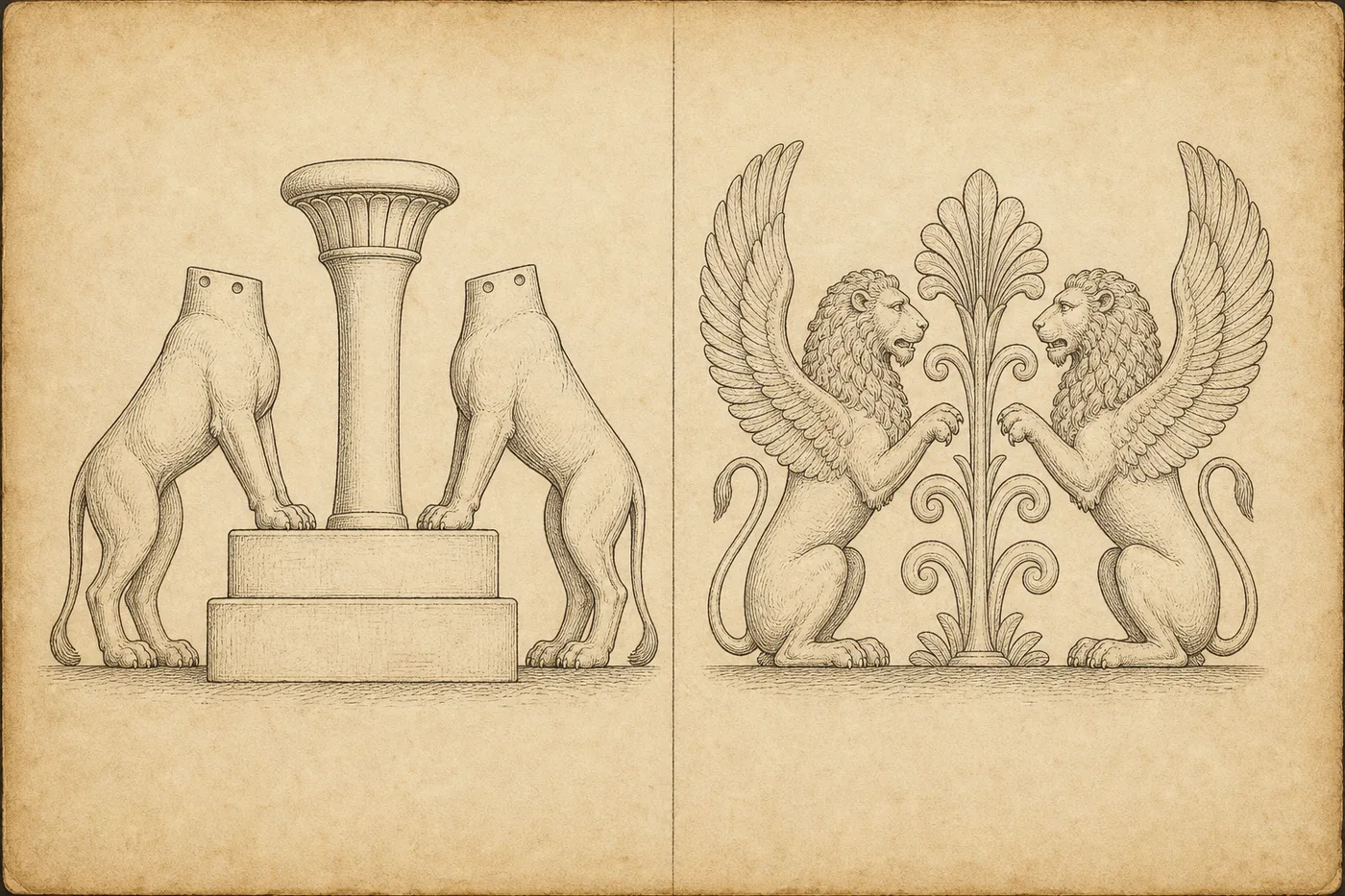
The column between the animals is the part that resists explanation. The arrangement is not invented at Mycenae; it is a formula found repeatedly on Minoan and Mycenaean seals and gold rings, where flanking animals attend a figure, a pillar, a tree or a shrine. What the pillar stands for at the gate is not recoverable from the gate. It has been read as a goddess in aniconic form, as a cult building shown by one of its parts, as the palace, and as the ruling house itself. Each reading has respectable support and none has won. An archive can say that the composition asserts something guarded and central without pretending to know its name.
The gate of the star
The second Lion's Gate is not an object but a morning. To follow it you need one piece of naked-eye astronomy, and it is worth setting out plainly, because almost everything claimed about the eighth of August depends on getting it right.
As Earth moves around the Sun, the Sun appears to travel through the fixed stars, drowning in daylight whichever of them it happens to be near. Any given star therefore has a season of invisibility — for Sirius, about seventy days — after which it reappears for a few minutes low in the east just before dawn, then sinks in the brightening sky. That first reappearance is the star's heliacal rising. It is a single dated morning, it recurs annually, and its date depends on where you are standing: on your latitude, on how clear the air is and how flat your eastern horizon is, and — over long spans of time — on the slow wobble of Earth's axis that astronomers call precession.
Sirius at a glance
- Designation
- Alpha Canis Majoris (α CMa); Sopdet in Egyptian, Sothis in Greek
- Apparent magnitude
- About −1.46 — the brightest star in the night sky
- Distance
- Approximately 8.6 light years, among the nearest stars to the Sun
- Primary
- Blue-white main-sequence star, spectral type near A1V, roughly twice the Sun's mass
- Companion
- Sirius B, a white dwarf of about one solar mass compressed to roughly Earth's size
- Discovery of the companion
- Inferred by Friedrich Bessel in 1844 from the star's wavering motion; first seen by Alvan Graham Clark in 1862
- Invisible season
- Roughly seventy days in the Sun's glare before the heliacal rising
In Egypt the star is Sopdet, rendered Sothis by the Greeks and identified in later periods with Isis, as the neighbouring figure of Sah was identified with Orion and with Osiris. In the third millennium BCE, at the latitude of Memphis, Sopdet's return fell close to the beginning of the Nile's inundation, the annual flood that made Egyptian agriculture possible. A star that reappears at the moment the river rises is not a symbol that needs arguing for. Her rising marked the opening of the year, wepet-renpet, and the association of that morning with renewal and with the arrival of abundance is genuinely ancient.

What Egypt did next created the problem that the modern date inherits. The civil calendar ran a flat 365 days with no leap day, so it lost a quarter of a day against the Sun and the stars every year, and a full day every four. Over centuries the calendar walked steadily away from the star, taking about 1,460 years to come back into agreement — the interval known as the Sothic cycle. A remark by the Roman writer Censorinus, that the rising and the first day of the civil year coincided in 139 CE, anchors the scheme, and Egyptologists have used it to date reigns ever since, with a running argument about how much precision it can bear.
The dog days
Outside Egypt the same star kept a different reputation. The Greek name Seirios carries the sense of scorching or searing, and the constellation that holds it, Canis Major, was understood as the dog of the hunter Orion — the Babylonian star lists had earlier called the same brilliant point the Arrow. Because the rising came in the worst heat of the Mediterranean summer, the star was blamed for the heat.
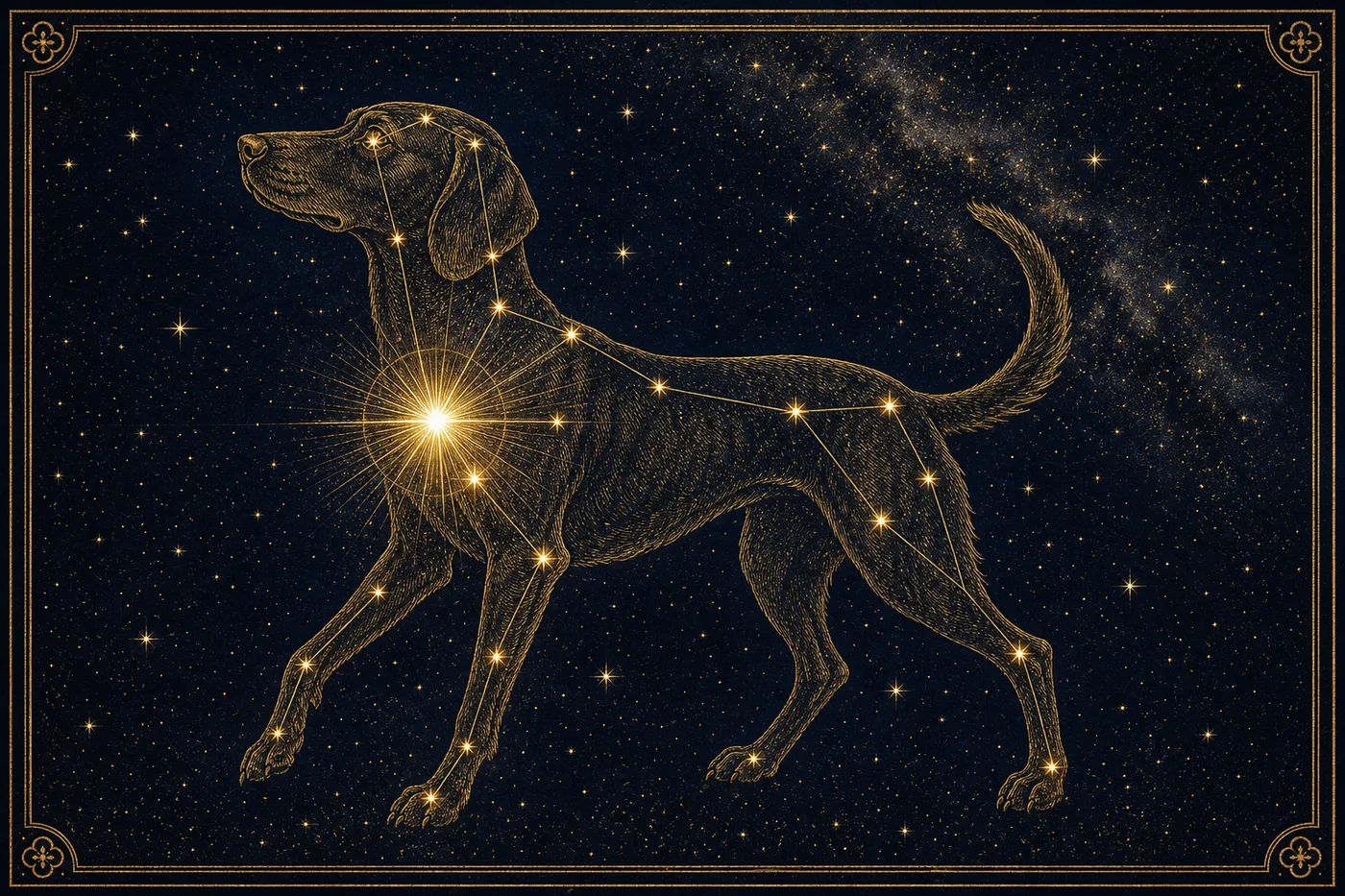
The inversion is worth stating plainly, because it is the sharpest thing the historical record has to say to the modern practice. For most of antiquity outside Egypt, the return of this star was a warning. It marked the point in the year when heat peaked, water failed and illness spread, and the almanacs that recorded it did so the way we record a hurricane season. The reading of the same event as an opening of blessing is not a survival of ancient tradition. It is a modern reversal of one.
The portal of 8/8
The third Lion's Gate is a date. In contemporary astrological and New Age practice, the eighth of August is kept as a gateway or portal that opens around the start of the month, peaks on the day, and closes after it. The observance is widely current online from about the 2010s onward and has become one of the busiest days in the popular-astrology calendar; the ideas it draws on are older, and belong to the modern esoteric tradition rather than to antiquity.
What the practice itself asserts, set out as its own claims rather than as findings: that the Sun on that date stands in the sign of Leo, the lion, which gives the gate its name; that Sirius is rising heliacally at the same season, so that the brightest star and the lion's sign are active together; that the doubled eight of 8/8 carries the numerological weight of abundance and, laid on its side, the lemniscate of the infinite; that the eighth trump of the tarot in the ordering used by most modern decks is Strength, whose image is a woman with a lion (see Esoteric Meanings); and that the geometry of Giza encodes an alignment to Sirius and to Orion's belt. Around these the observance has grown a practice: intentions written and spoken, meditation and breathwork on the day, journaling, ritual baths and altars, and a vocabulary of activation, upgrade and light-body that comes largely from late twentieth-century channelled literature.
The lineage of the central idea is traceable. Sirius as a spiritual centre — a source of teaching, initiation or higher influence — enters modern Western esotericism through Theosophy: Blavatsky treats the star as significant in her cosmology, and Alice Bailey states directly that the initiatory current behind Freemasonry descends from Sirius. Later movements inherited the star from them. In 1976 Robert Temple's The Sirius Mystery added a second and more spectacular claim, that the Dogon of Mali preserved ancient knowledge of the invisible companion Sirius B; the book was influential and the claim has not held up. Its method was criticised heavily on publication, and the ethnographic ground was cut away by Walter van Beek's later fieldwork among the Dogon, which found no such tradition and traced what had been reported to the expectations of earlier interviewers.
None of this makes the observance uninteresting or fraudulent. It is a living practice with a real content: it gives a fixed point in the year to intention and attention, it uses one of the strongest images available for that purpose, and it is doing openly what calendars have always done, which is to make a door out of a date. The archive's only requirement is that the strands stay labelled. The astronomy is checkable. The Egyptian new year is documented. The doctrine of Sirius as a teacher star is a nineteenth and twentieth-century development. The gate at Mycenae is a fortification in Greece and has no part in any of it.
Sorting the claims
Set out as the archive prefers to set such things out: what is asserted, what can be checked, and what belongs to interpretation.
| The claim | What is verifiable | What is interpretation |
|---|---|---|
| The Sun stands in Leo on 8 August. | True in the tropical zodiac, where the Sun occupies the sign of Leo from roughly 23 July to 22 August. In the constellations as they now stand, the Sun is in Cancer on that date. | That the Sun's presence in the sign lends the date a particular quality is an astrological reading, not an astronomical result. |
| Sirius rises heliacally on 8 August. | At Egyptian latitudes in the present epoch the first dawn reappearance of Sirius does fall in the first half of August. The date is set by latitude, horizon altitude and air clarity, and it moves with precession. | That one calendar date holds worldwide, or holds across history, does not follow. The rising is a local and drifting event. |
| Ancient Egypt observed this date as a gate. | Egypt tied its new year to the return of Sopdet, and its 365-day civil calendar slipped against that return by a day every four years. | No Egyptian text names 8 August, and none names a lion's gate. The fixed modern date is a modern artefact. |
| The doubled 8 of the date signifies abundance and infinity. | Nothing empirical is asserted here. The associations themselves are documented — the lemniscate, and Strength as the eighth trump in post-Golden Dawn tarot orderings. | Numerological, and traceable to nineteenth and twentieth-century occult systems rather than to antiquity. |
| Sirius aligns with the pyramids at Giza and with Orion's belt. | Egyptian monuments were laid out by stellar observation, and it has been argued since the 1960s that the southern shafts of the Great Pyramid point at the culmination of Sirius and of Orion's belt around the time of building. | The correlation theories built on those directions are contested and are not the consensus of Egyptology. No alignment recurs annually on a fixed date. |
| Sirius is a spiritual sun, a teacher or source star. | Astronomically Sirius is a hot main-sequence star with a white dwarf companion, 8.6 light years away. | A doctrine of the modern esoteric tradition, given its influential form by Blavatsky and Alice Bailey and elaborated in later channelled literature. |
| The Lion Gate at Mycenae is the gate the portal refers to. | The Mycenae gate is a fortification entrance of about 1250 BCE. No ancient source connects it with Sirius, with Egypt's new year, or with any date in August. | The link is a coincidence of English naming, and appears to be no older than the internet. |
Other lion gates
Readers arriving by search should know how many other gates carry the name, since none of them is the one they may be looking for.
Jerusalem. The Lions' Gate in the eastern wall of the Old City, Bab al-Asbat in Arabic, was built under Suleiman the Magnificent in the 1530s or 1540s as part of the Ottoman refortification. The pairs of heraldic felines flanking the arch, which give it its English name, are usually explained as earlier Mamluk carving reused in the Ottoman wall — the panthers of the sultan Baybars, moved and set into a new face. The gate is the traditional start of the Via Dolorosa and was the point at which Israeli paratroopers entered the Old City in 1967.
Hattusa. The Hittite capital in central Anatolia, walled in the second millennium BCE, has a Lion Gate of its own: two great lions carved in the round from the gate jambs, half emerged from the stone, facing outward at the approach. It is a close cousin of Mycenae in date and in purpose, and one of the reasons the Mycenae relief is read as a guardian group at all.
And elsewhere. Lion gates and lion bridges are scattered across Europe and Asia — Etruscan and Persian gate-lions covered in Etruria & Rome, the lion gates of Venetian fortresses across the Mediterranean, and modern civic monuments and bridges, the Lions Gate Bridge in Vancouver among them, that borrow the name for its weight rather than its history.
What the three share
Having kept them apart, it is worth saying what makes them confusable, and it is not carelessness. All three are thresholds, and all three put a lion at one.
The gate at Mycenae makes passage conditional: the ramp narrows, the door closes, and the beasts above the lintel state the condition. The rising of Sirius makes a year begin at a visible door in the sky — a star that was absent and is now present, so the count may start again. The eighth of August makes a threshold out of the calendar itself, with no stone and no horizon required. Each takes an unmarked continuum — a wall, a year, a sequence of days — and installs a point at which something changes, then puts a guardian on it.
That recurrence is the archive's actual subject, and it should not be oversold. The winged lions of Assyria, the griffins of Greece, the evangelist's lion over a Venetian door and the lion of an August date are not one tradition handed down. The lines of descent that can be documented are documented in the chapters on those cultures, and where they run out this archive says so. What can be said is that the largest predator most of these societies knew is the figure they reach for when a boundary needs to mean something, and that the reach is made again in each generation rather than inherited from the last. Recurrence is not descent. It is a statement about us.
For the star at the lion's own heart, seeRegulus; for the constellation and the sign, Leo; for the grammar of the hybrid, Anatomy of the Motif. The works behind this chapter are listed in Sources & Further Reading.