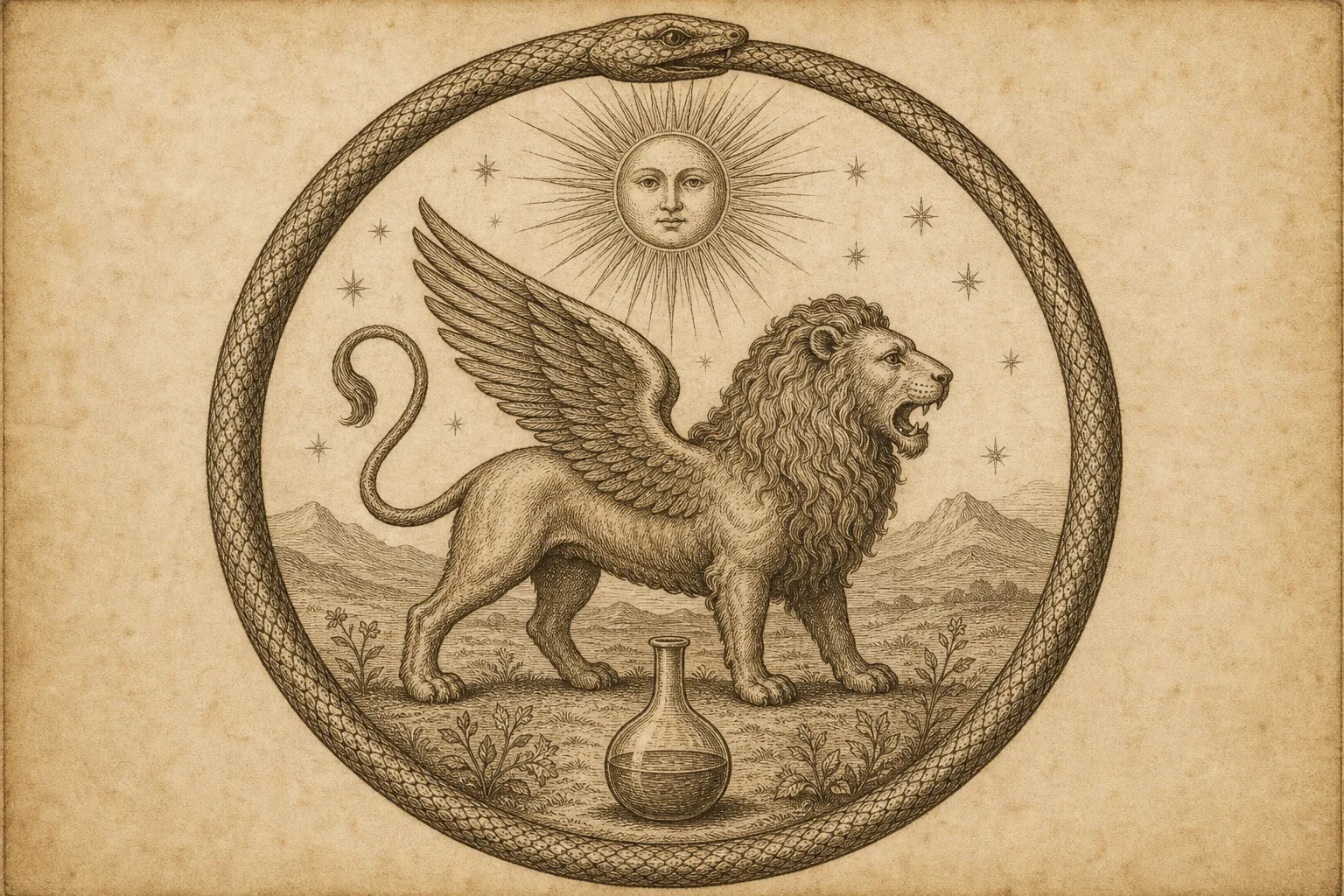
Every other chapter in this archive describes objects: a relief from a specific palace, an ivory from a specific workshop, a star at a measurable distance. This one describes what people have said those objects mean. That is a different kind of claim, and it needs different handling — because the moment a symbolic reading is written in the same voice as a dated find, it starts to pass for one.
The rule this chapter follows
Historical claims here are dated and attributed: this text, this century, this tradition. Symbolic readings are presented as readings — positions held by named traditions and identifiable authors, not properties of the objects. The distinction is not pedantry. An Assyrian sculptor carving a lamassu in the ninth century BCE and a nineteenth-century occultist assigning that same creature to a zodiacal quarter are doing unrelated things, and the second tells you nothing about the first.
Kept that way, the material is worth studying closely. It is a two-thousand-year record of what people found compelling in an image, and the fact that the readings cluster — force under governance, the threshold, the fourfold, the solar heart — is itself a historical observation about the symbol's durability.
Strength joined to air
A lion is the densest available image of terrestrial force: weight, muscle, claw, territory, predation. Wings belong to the other category entirely — air, distance, the sphere of birds and of gods, freedom from the ground that a lion is precisely the master of. The winged lion puts the two in one body.
That is not zoological confusion. The people who carved these creatures knew what lions looked like, and several of them had seen one. The combination is deliberate, and it is why the motif survives across cultures that share nothing else. Wings on a predator make a claim about hierarchy: the strongest thing in the visible world is shown as belonging to a higher order, and therefore as answerable to it.
One caution about method: a symbol's meaning is not fixed by its parts. The same hybrid served as a royal boast on an Assyrian gate, a funerary guardian in Etruria, and an evangelist's emblem in Venice. Parts constrain meaning. Use determines it.
The guardian who tests
Winged lions are almost never placed at random. They stand at gates, at the heads of stairs, beside tomb doors, flanking thrones, on harbour columns, at the top of a page where a text begins. The recurring position is the threshold: the point where one kind of space becomes another.
The Assyrian lamassu is the ancestor of the type, and its details are instructive. The colossi were carved in pairs, one each side of a doorway, so that entering meant passing between them. Many were cut with five legs, so that from the front the creature stands still and from the side it strides — at rest for the one who approaches, in motion for the one who passes. Assyrian practice also buried small protective figurines beneath thresholds, which shows the visible colossus and an invisible apparatus of protection working as one system. The archaeology is set out inthe Mesopotamian chapter.
The lineage runs from Assyrian gateways through Egyptian sphinx avenues, Etruscan tomb façades and Chinese gate lions to the heraldic supporters flanking a shield and the stone lions on the steps of nineteenth-century banks. The institutions differ completely. The posture — two animals, one entrance, a passage between them — does not.
The four-fold schemes
The lion enters the Western symbolic system in a set of four. Ezekiel's opening vision describes four living creatures, winged, each with four faces — human, lion, ox and eagle. Revelation describes four living creatures around a throne, each with a single face from the same list. The Christian assignment to the evangelists took centuries to settle: Irenaeus in the second century gave the lion to John, while the arrangement that became standard is Jerome's. That is how the winged lion becomes the emblem of Mark, and eventually of Venice — traced inthe chapter on Christian tradition.
A later layer maps the same creatures onto the four fixed signs of the zodiac, using the tradition's substitution of an eagle for the scorpion. The scheme appears in Renaissance occult philosophy and became near-universal in nineteenth-century occultism, in Éliphas Lévi and in the Hermetic Order of the Golden Dawn, from which it passed into the Tarot decks most people have handled.
| Creature | Evangelist, after Jerome | Fixed sign in the later scheme | Element in that scheme |
|---|---|---|---|
| Lion | Mark | Leo | Fire |
| Ox | Luke | Taurus | Earth |
| Eagle | John | Scorpio, by substitution for the scorpion | Water |
| Man | Matthew | Aquarius | Air |
The columns of that table come from three different centuries. Only the first is biblical.
The lions of the laboratory
Alchemical texts are written in cover names, and their images work the same way: a picture stands for a substance, an operation, a stage of the work, or several at once. Historians of early chemistry — above all William Newman and Lawrence Principe — have shown that many of these cover names can be resolved into concrete laboratory materials and reproduced at the bench. That cuts both ways. The images are not merely mystical fog, and the decoding has to be done text by text rather than by consulting a symbol dictionary.
The green lion devouring the sun is the most reproduced lion in the corpus. It appears in the woodcut sequence of theRosarium philosophorum, printed in the mid-sixteenth century, and on the painted Ripley scrolls: a green lion swallowing or biting into a solar disc. The reading most often given is chemical — a powerful solvent attacking gold, with vitriol-derived acids or aqua regia as the usual candidates. Others identify the green lion with antimony ore, and others again with unrefined first matter, green in the sense of unripe.
The red lion generally belongs later in the sequence, associated with the fixed masculine principle and with the reddening that marks the work's final stage. And the emblem books use one convention that explains the winged lion's presence in alchemy at all: wings mark the volatile, their absence the fixed. A winged and a wingless animal shown together — lions in some plates, dragons in others — are the two principles the operation must marry. Michael Maier's Atalanta fugiens of 1617, combining engravings, epigrams and music, is the best-known place to watch this visual grammar work at length.
Read against that grammar, a winged lion is a compact statement of the whole procedure: the fixed thing given volatility, matter made able to rise without ceasing to be itself.
Sun, gold and the heart
The lion is the Sun's animal in almost every system that assigns animals to planets. The correspondence tables of Renaissance natural magic — the most influential being those in Agrippa'sThree Books of Occult Philosophy of 1533 — gather into the solar column gold among metals, the lion among beasts, the cockerel among birds, sun-following plants among herbs, and the heart among the organs. The logic is analogical throughout: gold does not tarnish, the lion does not yield, the heart is central and does not rest, and the Sun visibly rules its sphere.
Medical astrology gives the chain a body, assigning the heart to Leo in the zodiac-man diagrams of medieval and Renaissance medicine, with the Sun ruling both. That is why the naming of Regulus matters to the esoteric reading: the star sits at the heart of the animal that stands for the Sun, making it, in the tradition's own terms, the heart of the heart. The astronomy — and the tropical-zodiac footnote that usually gets garbled in retelling — is in the Regulus chapter. Adding wings to a solar lion is, in this frame, a second lift applied to something already at the top of its own ladder.
Courage, lodges and cards
Freemasonry
Masonic use of the lion is real but narrower than popular accounts suggest. The Lion of Judah is invoked in the third degree, and the grip associated with it — the lion's paw — belongs to that degree's ritual of raising, where Masonic commentary reads the lion as strength and as resurrection. In the Royal Arch, the banners of the principal tribes carry the lion, the man, the ox and the eagle: the tetramorph again, installed in a different institution. The lodges invented none of this; they inherited a biblical repertoire and gave it new ceremonial placement.
Tarot
The card usually cited is Strength, showing a woman with a lion, opening or closing its jaws with no visible effort. It is numbered XI in the Marseille pattern and VIII in the Rider–Waite–Smith deck, which follows the Golden Dawn in swapping it with Justice. The standard reading is force mastered by composure rather than by violence — a direct visual version of the governed-strength idea running through this chapter.
Worth stating precisely: the lion on Strength has no wings. The winged lion appears elsewhere in the same decks, in the corners of the Wheel of Fortune and the World, where the four creatures are drawn as the fixed signs. Accounts that merge the two are describing something the cards do not contain.
The psychological reading
Carl Jung, in Psychology and Alchemy of 1944 and later inMysterium Coniunctionis, treated alchemical imagery as material in which unconscious processes had been projected onto matter, and read the lion as instinct or raw affect — energy to be integrated by consciousness rather than suppressed by it. In that reading the winged lion is instinct brought into relation with awareness: recognisably the old formula in twentieth-century clinical vocabulary.
Historians of chemistry have criticised the approach sharply, arguing that it tells us about Jung rather than about what alchemists were doing in their workshops. Both can hold. Jung is poor evidence about the sixteenth century and good evidence about the twentieth, where his reading became a tradition of interpretation in its own right — and remains the frame through which most modern readers meet these images at all.
How to read a winged lion
The practical payoff of this chapter is a procedure. Faced with a winged lion on a building, a coin, a manuscript page or a museum plinth, look at these things, in this order, before deciding what it means.
- The head. A human head means a lamassu or a sphinx; an eagle head and beak mean a griffin; a lion head means the lion itself. The head assigns the family before anything else does.
- The wings. Count them and note their position. Four wings point to the biblical cherub rather than the classical griffin. Raised wings usually signal action; folded wings, repose or guardianship.
- The posture. Standing, striding, seated, reclining, rearing. Guardians characteristically stand or stride; heraldic and emblematic lions sit, rear or recline.
- What it stands on. A plinth, a column, a book, a globe, a wheel, a defeated animal, water. The support often carries more meaning than the creature.
- What it holds or wears. An open book, a sword, a key, a crown, a collar. Attributes turn a generic hybrid into a named figure, and their absence is informative too.
- Where it is placed. Gate, tomb, throne, altar, coin, flag, façade, letterhead. Placement is the strongest single clue to function, because function is what placement is for.
- Scale and material. Colossal stone at an entrance is state power. Small ivory, a seal or a pendant is portable, personal or commercial. Gilding and pigment indicate who was paying.
- Whether there are two. A facing pair means a threshold. A single animal usually means an emblem — of a city, an office, a person, a brand.
How to read the symbol
- Head
- Assigns the family: human head, lamassu or sphinx; eagle head, griffin; lion head, the lion itself
- Wings
- Mark the register — an earth animal shown as belonging to the sphere above it
- Posture
- Guardians stand or stride; emblems sit, rear or recline
- Support and attributes
- What it stands on and what it holds turn a generic hybrid into a named figure
- Placement
- Gate, tomb, throne, coin or flag — position states the function
- Pairing
- Two facing animals mean a threshold; one alone means an emblem
- Attribution
- Every symbolic claim belongs to a tradition and a date; the object shows only form and place
That list is deliberately about what is visible. Meaning arrives afterwards, from a tradition, and should be named as such when it does. For the comparative anatomy behind step one — how to tell a lamassu from a griffin from a sphinx from a cherub — go back toAnatomy of the Motif. For the works and editions behind the material quoted here, see Sources.